

Europe by Train 101: The Ultimate Beginner’s Guide to Effortless Rail Travel
This guide is part of our Ultimate Europe Travel Guide – your complete resource for planning European adventures.
Europe by Train 101, a complete, long-form, step-by-step roadmap to navigating Europe’s rail system with confidence.
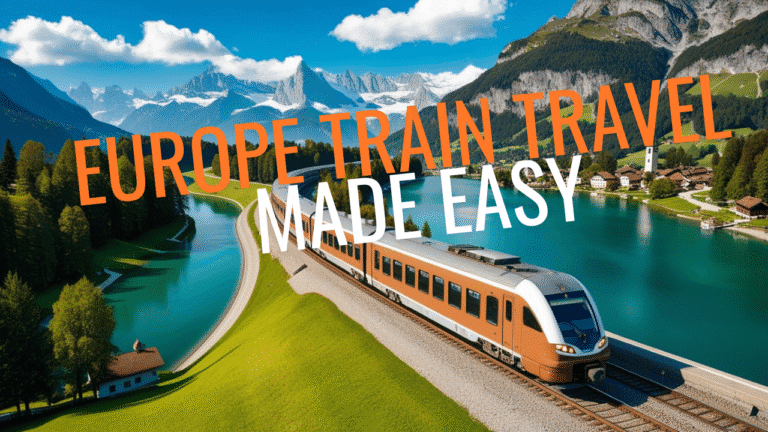
Traveling Europe by train is one of the continent’s greatest pleasures. It’s scenic, sustainable, intuitive, and far less stressful than navigating airports, no long security lines, baggage restrictions, or complicated transfers. Instead, your journey becomes part of the adventure: quiet platforms, panoramic windows, and the freedom to hop between countries at your own pace.
Whether you’re planning your first route from Paris to Rome or mapping a multi-country adventure through castles, vineyards, and Alpine valleys, this guide explains everything you need to know, from passes and bookings to etiquette, budgeting, comfort hacks, and expert route-planning strategies.
Before planning any major trip, read:
Essential Travel Planning Strategies to Save Time, Money, and Stress.
Table of Contents
-
Why Travel Europe by Train?
-
How Europe’s Rail Network Works
-
Eurail vs. Interrail: Which Pass Do You Need?
-
When to Choose Point-to-Point Tickets
-
How to Plan Your Route (Tools, Timelines & Beginner Examples)
-
The Best Scenic and Iconic Train Routes
-
Budget Tips for Train Travelers
-
Packing, Comfort & Luggage Hacks
-
Train Etiquette Across Europe
-
Safety, Accessibility & Family Travel Tips
-
Expanded FAQs for First-Time Train Travelers
-
Printable Planning Checklist
-
Final Thoughts
Table of Contents
Toggle1. Why Travel Europe by Train 101?

Europe’s train network is one of the best in the world; fast, clean, interconnected, and remarkably accessible. It’s not only efficient but also deeply enjoyable. Instead of passing over landscapes at 30,000 feet, you glide right through them.
Benefits at a Glance
✓ City-center to city-center convenience
Train stations are located in the heart of cities, saving hours compared to airports.
✓ Sustainability
Trains emit dramatically less carbon than planes or rental cars.
For more on eco-conscious planning, read:
How Sustainable Tourism Is Evolving in 2025.
✓ Comfort + space
Enjoy large seats, walkable aisles, and scenic windows, often with café cars.
✓ Flexibility
Many routes run several times per hour, especially in Western Europe.
✓ Effortless border crossings
For Schengen countries, crossing borders is seamless; no passport queues.
✓ Scenic immersion
Switzerland’s Alps, France’s lavender fields, Germany’s castle valleys, Italy’s coastline — you see them all up close.
2. How Europe’s Rail Network Works
Europe’s rail ecosystem is a combination of four main train types. Understanding the differences helps you book smarter and choose the right pass or ticket.
High-Speed Trains (Fastest & Most Direct)
These are the backbone of major intercity travel.
Examples:
-
Eurostar (London ↔ Paris/Brussels/Amsterdam)
-
TGV (France)
-
ICE (Germany)
-
Frecciarossa (Italy)
-
AVE (Spain)
Speed: 250–320 km/h
Best for: long distances, multi-country trips
Reservation needed: Yes (mandatory on most)
Intercity Trains (Medium-Fast, Comfortable)
Examples:
-
IC (Germany)
-
InterCity (Italy)
-
Intercités (France)
These are great for medium distances and typically cost less.
Regional Trains (Slower but Flexible)
Examples:
-
TER (France)
-
REX (Austria)
-
Regio (Germany)
-
Regionali (Italy)
Best for:
Exploring smaller towns, day trips, budget travel, and scenic countryside.
Night Trains (Save Money + Time)
Major night-train networks include:
-
Nightjet (Austria → Germany, Italy, Switzerland)
-
Intercités de Nuit (France)
You can book sleeper cabins, couchettes, or seats.
Night trains are one of the best ways to save money. Learn more in:
10 Effective Transportation Hacks for Budget Travelers.
3. Eurail vs. Interrail: Which Pass Do You Need?
Understanding train passes is one of the biggest challenges for first-time travelers, but once you understand the basics, choosing becomes easy.
Who should buy which pass?
-
Eurail Pass → Non-European residents
-
Interrail Pass → European residents
They both cover trains in 33 countries.
Types of Rail Passes
Global Pass
Best for travelers exploring 3+ countries.
One Country Pass
Ideal if you want to explore a single country thoroughly:
-
Italy
-
France
-
Switzerland
-
Germany
-
Spain
-
Norway
-
Austria
Continuous vs. Flexi Passes
Continuous Pass
Travel any day, back-to-back.
Best for fast-paced backpacking or last-minute changes.
Flexi Pass
Travel a certain number of days within 30 days.
(Example: 5 travel days in 1 month.)
Best for slow travel or travelers with pre-booked accommodations.
When a Pass Is Worth It
A pass saves money when:
-
You’re visiting multiple countries
-
You want flexibility
-
You’re traveling long distances
-
You’re booking late (when single tickets get expensive)
When a Pass Is NOT Worth It
A pass may cost more when:
-
You book high-speed trains early
-
You prefer a slow, local route
-
You travel only 2–3 legs
To compare rail passes vs. tickets accurately, use the Eurail Planner app.
4. When to Choose Point-to-Point Tickets Instead
Point-to-point tickets are often best when:
-
You already know your exact travel dates
-
You can book 2–3 months ahead
-
You want the lowest possible price
-
You’re traveling mainly within one country
Best Booking Websites
-
Trainline (the easiest for beginners)
-
Deutsche Bahn (covers all Europe)
-
SNCF Connect (France)
-
ÖBB (Austria)
-
Trenitalia (Italy)
-
Renfe (Spain)
Price Tip: Book Early
European trains use dynamic pricing, much like flights.
Booking early can save up to 50%.
For more cost-saving techniques, check out:
9 Proven Budget Travel Hacks to Save $500.
5. How to Plan Your Route (Tools & Beginner Examples)
Planning your route is where many new travelers feel overwhelmed, but it becomes simple with a clear step-by-step process.
Step 1 — Choose 3–5 Key Destinations
Too many stops leads to burnout and rushed sightseeing.
Good beginner combinations include:
-
Paris → Amsterdam → Berlin → Prague
-
Zurich → Milan → Florence → Venice
-
Munich → Salzburg → Vienna → Budapest
Need destination ideas? Read:
Top Emerging Destinations 2025.
Step 2 — Map Your Route Logically
Avoid zig-zagging across the continent.
Choose a flow such as:
-
West → East
-
North → South
-
Central Europe → Southern Europe
Step 3 — Check Train Schedules
The best apps:
-
Eurail App
-
DB Navigator
-
Omio
-
Rail Planner
These tools show platforms, transfers, and whether reservations are required.
Step 4 — Book High-Speed Trains Early
This ensures:
-
Low prices
-
Good seat selection
-
Smooth connections
Book 60–90 days ahead when possible.
Step 5 — Stay Close to Major Stations
This saves money, time, and stress.
Examples:
-
Near Amsterdam Centraal
-
Near Paris Gare du Nord
-
Near Rome Termini
-
Near Milan Centrale
Before choosing neighborhoods, read:
Avoid Tourist Traps in Europe.
Beginner Sample Itinerary (Simple & Practical)
Here’s a great starter itinerary using easy train connections:
Day 1–3: Paris
Day 4–5: Amsterdam (3h 20m from Paris)
Day 6–7: Berlin (6–7 hours from Amsterdam)
Day 8–10: Prague (4 hours from Berlin)
Day 11–12: Vienna (4 hours from Prague)
Day 13–14: Rome via Venice
Note: This is different from your immersive itinerary post. Here it’s purely practical for beginners.
6. The Best Scenic and Iconic Train Routes
Europe’s beauty is unmatched from the rails. If you want views that make the journey as rewarding as the destination, add some of these to your list.
Top Scenic Routes
✔ Zurich → Milan (Gotthard Panorama Route)
Spiraling tunnels, glacial rivers, Alpine valleys.
✔ London → Edinburgh
Cliffs, sea views, rolling English countryside.
✔ Munich → Salzburg
Misty hills, lakes, and Sound of Music landscapes.
✔ Oslo → Bergen (Norway)
One of the world’s most beautiful routes.
✔ Cinque Terre Local Trains
Cliffside towns overlooking turquoise waters.
✔ Bernina Express
UNESCO-listed Swiss scenery with panoramic windows.
For ecological travel inspiration, read:
Top 10 Eco-Friendly Travel Destinations.
7. Budget Tips for Train Travelers
Train travel doesn’t need to be expensive. With the right strategy, you can significantly reduce costs.
✔ Book early
Savings of up to 70%.
✔ Use night trains
Save a hotel night.
✔ Travel midweek
Fares drop significantly Tuesdays–Thursdays.
✔ Use country-specific discount cards
Examples:
-
Germany’s Deutschlandticket
-
Switzerland’s Half-Fare Card
-
Italy’s regional offers
✔ Avoid peak summer travel
July–August prices spike dramatically.
Shoulder seasons are best — April–June and September–October.
✔ Compare passes vs. point-to-point carefully
Sometimes a simple ticket is cheapest.
For more budget strategies, read:
How to Travel on a Budget.
8. Packing, Comfort & Luggage Hacks
Train travel gives you more flexibility with luggage — but organization still matters.
Recommended Essentials
-
Universal adapter
-
Power bank
-
Light snacks
-
Refillable water bottle
-
Light blanket or scarf
-
Travel pillow for long rides
-
Offline maps
-
Multi-use jacket
Download your minimalist packing guide:
One-Bag Packing List (Free Spreadsheet).
9. Train Etiquette Across Europe
Good etiquette keeps the journey smooth for everyone.
Do:
✓ Lower your voice
✓ Keep bags out of the aisle
✓ Validate paper tickets
✓ Offer seats to elderly passengers
✓ Line up properly when boarding
Don’t:
✗ Eat messy or strong-smelling foods
✗ Block doors with luggage
✗ Use speakerphone
✗ Assume reservations aren’t mandatory
For more etiquette and safety guidance, read:
Solo Female Travel Safety Tips.
10. Safety, Accessibility & Family Travel Tips
Safety
Trains are extremely safe, but keep valuables close, especially on night trains and in crowded stations.
Accessibility
Modern trains have wheelchair spaces, ramps, and accessible bathrooms. Stations like Zurich, Vienna, and Stockholm have excellent accessibility.
Family Travel
Trains are ideal for families — flexible, spacious, stroller-friendly, and entertaining for kids.
See also:
Sustainable Travel Guide for Families.
11. Expanded FAQs for First-Time Rail Travelers
Do I need to print my tickets?
Digital tickets are accepted on most routes, but printing is still recommended on small regional lines.
How early should I arrive?
20–30 minutes is usually enough. For Eurostar, arrive 60–90 minutes early.
Can I bring food?
Absolutely. Picnicking on trains is common.
Is Wi-Fi available?
High-speed trains usually offer free Wi-Fi; regional trains vary.
Do trains ever sell out?
High-speed and night trains do. Regional trains rarely do.
12. Printable Planning Checklist
Before You Go:
☐ Choose 3–5 core destinations
☐ Download Eurail or DB Navigator app
☐ Decide pass vs. tickets
☐ Book long-distance trains early
☐ Check reservation requirements
☐ Book hotels near stations
Packing:
☐ Power bank
☐ Water bottle
☐ Offline maps
☐ Snacks
☐ Travel pillow
☐ Light jacket
☐ Portable charger
☐ Universal adapter
On the Trip:
☐ Validate paper tickets
☐ Check platform screens
☐ Keep valuables close
☐ Arrive early for high-speed routes
13. Final Thoughts

Traveling Europe by train is more than a way to get from point A to point B; it’s a window into the continent’s soul. Mountains, towns, rivers, and coastlines pass just beyond the glass, offering a deeper, slower, more immersive way to explore.
If you’re a first-time traveler, this guide gives you all the tools you need to plan confidently, save money, and enjoy each journey as much as the destination.
Next Reads:
• Road Trip Planning Guide
• Top Adventure Travel Destinations for Thrill Seekers
• What to Pack in a Travel Emergency Kit
14. FAQs About Traveling Europe by Train 101
1. Is it cheaper to fly or take the train in Europe?
It depends on your route. Budget airlines can be cheaper for long distances if booked early, but trains often win on convenience, time saved (no airport transfers), and environmental impact. Plus, short regional routes are often cheaper and less stressful than flying.
2. How do Eurail Passes work?
A Eurail Pass lets you travel on most European trains with one flexible ticket. You can choose between continuous passes (unlimited travel days in a set period) or flexi passes (a specific number of travel days in a month). Always check if reservations are needed for high-speed or night trains.
3. What is the best time to travel Europe by train?
The best seasons are spring (April–June) and autumn (September–October). You’ll enjoy mild weather, fewer tourists, and better prices. Winter can be beautiful for snowy mountain routes, but summer often brings heat and crowds.
4. Can I bring luggage on European trains?
Yes! Most trains allow two large bags and one small carry-on, with no strict weight limits. Keep valuables close, especially on overnight journeys.
5. Do trains in Europe have Wi-Fi and food service?
Many long-distance and high-speed trains (like Eurostar or TGV) offer free Wi-Fi, charging outlets, and bistro cars with snacks and drinks. However, smaller regional trains might not, so pack your own snacks.
6. Are seat reservations mandatory?
Not always. Some routes, like France’s TGV or Italy’s Frecciarossa, require reservations, while local and regional trains generally don’t. Always check your route details on the Eurail or Trainline apps.
👉 For more info: 10 Effective Transportation Hacks for Budget Travelers
👉 Additional resources:
Seat61.com – for train info by country
Eurail.com – official pass site
Interrail.eu – European rail passes
Nightjet.com – night train routes
Bahn.com – German and EU train schedules
EU Passenger Rights – official travel rights info



 English