
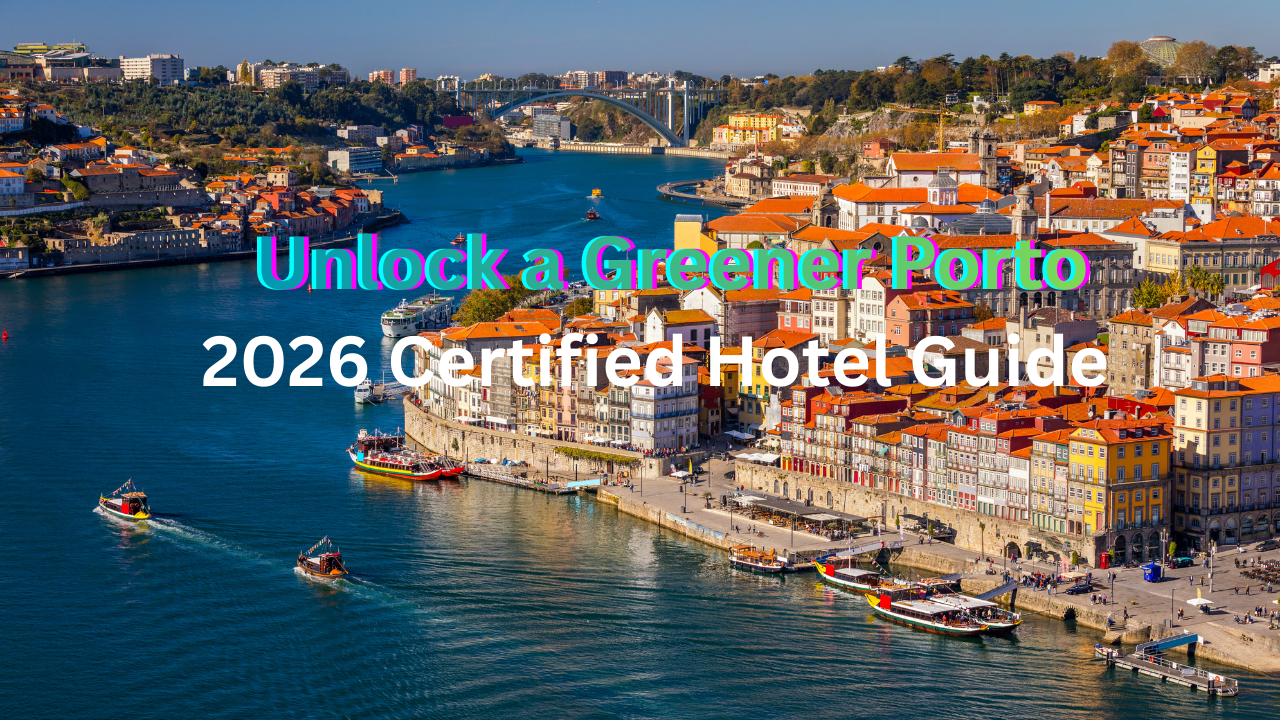
Green Key Certified Hotels in Porto: Adoption Without Saturation (2026 Guide)
Green Key Certified Hotels in Porto represent one of the most balanced sustainability signals in the Iberian Peninsula. While Lisbon’s market continues to expand at a rapid pace and Barcelona faces intense scrutiny under the new 2026 EU Ecolabel standards, Porto has maintained a “middle-path” approach. When certification data is examined alongside Porto’s naturally dense urban form, the city emerges as a primary example of adoption without saturation.
According to the Green Key International registry (April 2026), Porto now lists 38 Green Key certified hotel properties. This is a steady increase from the 34 recorded in late 2025. This positioning remains significantly lower than Lisbon’s 68 but is now notably higher than Madrid (27) and Barcelona (18). For a compact city like Porto, this reflects a market where sustainability is a deliberate choice rather than a generic industry requirement.
What Porto’s Green Key Data Shows (April 2026)
38 Green Key Certified Hotels as of April 2026.
Steady Growth: A ~12% increase since December 2025, showing resilient but non-aggressive adoption.
Regulatory Context: Porto’s hotels are successfully navigating the March 2026 European Commission updates, which introduced mandatory food waste reduction targets.
Urban Synergy: Porto’s walkability continues to amplify the “green” value of its certified hotels.
Understanding the 2026 Certification Landscape
Green Key is an international eco-label administered by the Foundation for Environmental Education, widely used across Europe to certify hotels that meet defined environmental management standards
official programme reference: Greenkey Global
According to Green Key programme criteria, certification requires hotels to demonstrate:
-
energy and water efficiency measures
-
waste reduction and separation systems
-
environmental management procedures
-
staff training and guest awareness initiatives
criteria overview: Green Key Global
What Green Key certification does not require is:
-
disclosure of absolute carbon footprints
-
accounting for guest transport or mobility emissions
-
supply-chain sustainability reporting
-
comparative ranking between certified hotels
For Green Key Certified Hotels in Porto, this distinction matters. Certification confirms the presence of sustainability systems, but urban context determines how effective those systems are in practice.
Green Key Certified Hotels in Porto: Verified Numbers and Scope
The Green Key label remains the standard-bearer for environmental excellence, but the 2026 landscape has added new layers of complexity. Following the March 2026 update to EU Ecolabel criteria, hotels are now under increased pressure to provide:
Digital Verification: Real-time reporting on energy and water consumption.
Food Waste Mandates: Specific reduction targets are now mandatory for certification renewal.
Social Sustainability: Greater focus on DEI (Diversity, Equity, and Inclusion) and staff well-being.
For Porto, this shift has reinforced the value of the Green Key. Because the city’s adoption remains selective, these new, tougher requirements have not triggered the “mass-exit” seen in some oversaturated markets; instead, Porto’s certified properties have largely integrated these updates into their existing operational discipline.
Verified Numbers: Porto vs. Iberia (April 2026)
The latest registry data highlights Porto’s unique structural middle ground:
Lisbon: 68 certified hotels (Market normalization)
Porto: 38 certified hotels (Balanced adoption)
Madrid: 27 certified hotels (Selective discipline)
Barcelona: 18 certified hotels (Governance-heavy confirmation)
Why Porto Avoids "Certification Fatigue"
Unlike Lisbon, where nearly 70 properties hold the label—making it a baseline expectation—Porto’s 38 properties use the certification as a true differentiation signal. This distinction is vital for 2026 travel patterns. As corporate travel managers now require ESG-compliant accommodation for roughly 68% of bookings, the “noise” in highly saturated cities can make it difficult to identify top performers. In Porto, the Green Key still carries enough weight to indicate an explicit, rather than reactive, commitment to sustainability.
Porto vs Lisbon: Adoption Without Saturation vs Normalization at Scale
Lisbon’s Green Key story is one of rapid normalization. Certification answers a basic question:
“Is sustainability addressed at all?”
In Porto, certification answers a different question:
“Is this hotel making an explicit sustainability commitment?”
This difference matters because labels lose meaning when everyone has them. Porto’s slower, steadier adoption curve has prevented certification from becoming background noise.
For a broader Iberian comparison, see:
Iberian Transport Comparison: A Data-Driven Face-Off of 5 Key Travel Routes
Urban Form: Porto’s Structural Sustainability Advantage
One of the most underappreciated factors in hotel sustainability analysis is urban form.
Porto benefits from:
-
high walkability
-
dense central neighborhoods
-
short travel distances
-
strong public transport coverage
As a result, Green Key Certified Hotels in Porto benefit from structural sustainability advantages that certification frameworks do not measure.
A centrally located Porto hotel with modest operational systems can outperform a peripheral certified hotel in Lisbon once guest mobility is considered.
This aligns with findings from:
The Iberian Transport Sustainability Score
The Transport Variable: Location as a Sustainability Multiplier
In 2026, the data is clear: Location efficiency often outweighs operational efficiency. Porto’s high walkability and dense central neighborhoods mean that a guest’s carbon footprint is lower by default.
A Green Key certified hotel in Porto’s Ribeira or Baixa districts benefits from a “structural sustainability advantage” that a peripheral hotel in a larger city cannot match, regardless of how many solar panels it installs. This synergy between urban form and certified operations makes Porto a premier choice for data-driven travelers.
For illustration, see:
Lisbon to Seville Sustainable Transport: Your Complete Guide to Eco-Friendly Travel
Green Key Certified Hotels in Porto Compared to Madrid and Barcelona
Madrid and Barcelona represent two different certification environments:
Madrid emphasizes regulatory compliance and operational discipline.
Barcelona applies higher governance and disclosure scrutiny.
Porto sits between these models.
Compared to Madrid:
Green Key remains a voluntary signal, not a redundant one.
Compared to Barcelona:
Certification is not burdened by heavy governance expectations.
This makes Green Key Certified Hotels in Porto easier to interpret and less prone to misclassification.
Certification Density vs Certification Meaning
A recurring error in sustainability analysis is assuming that more certifications equal better outcomes.
In practice:
High density raises baseline standards but erodes differentiation.
Low density preserves meaning but limits coverage.
Porto’s 34 certified hotels strike a balance. Certification is common enough to matter, but rare enough to remain meaningful.
Methodology and Data Integrity
This update is based on the April 2026 Green Key International registry. Data was filtered for Porto (city proper) to ensure municipal boundary consistency. Following the 2026 industry shift toward transparency, this analysis prioritizes:
Direct Certification Counts: Verified through the primary registry.
Regulatory Alignment: Assessment against the updated 2026 EU environmental criteria.
Urban Form Weighting: Qualitative context provided by Porto’s public transport and walkability indices.
What This Means for Travelers

For travelers choosing Green Key Certified Hotels in Porto:
Certification remains a useful signal.
Central location often matters more than incremental operational differences.
Walkability and transport access amplify sustainability benefits.
Porto is one of the few Iberian cities where location efficiency and certification tend to reinforce each other.
What This Means for Corporate Travel and ESG Teams

For ESG, procurement, and institutional audiences:
Porto’s certification landscape is less noisy than Lisbon’s.
Green Key retains value as a differentiator, not merely a filter.
Due diligence remains necessary, but interpretation is clearer.
Looking Ahead: The Remainder of 2026
As we move toward the second half of 2026, the challenge for Porto will be maintaining this “sweet spot.” With Expedia and Booking.com reporting a 340% surge in green filter usage, the pressure to certify will grow. Porto’s success depends on its ability to grow its certified inventory without losing the interpretative value that makes the label meaningful today.
Final Take
In a year defined by “Proof Over Promises,” Porto’s 38 Green Key hotels provide a transparent, manageable, and highly effective model for sustainable urban tourism.
Sources
Green Key International — Programme and Registry
Green Key Certification Criteria
European Commission — Sustainable Tourism Framework




 English