
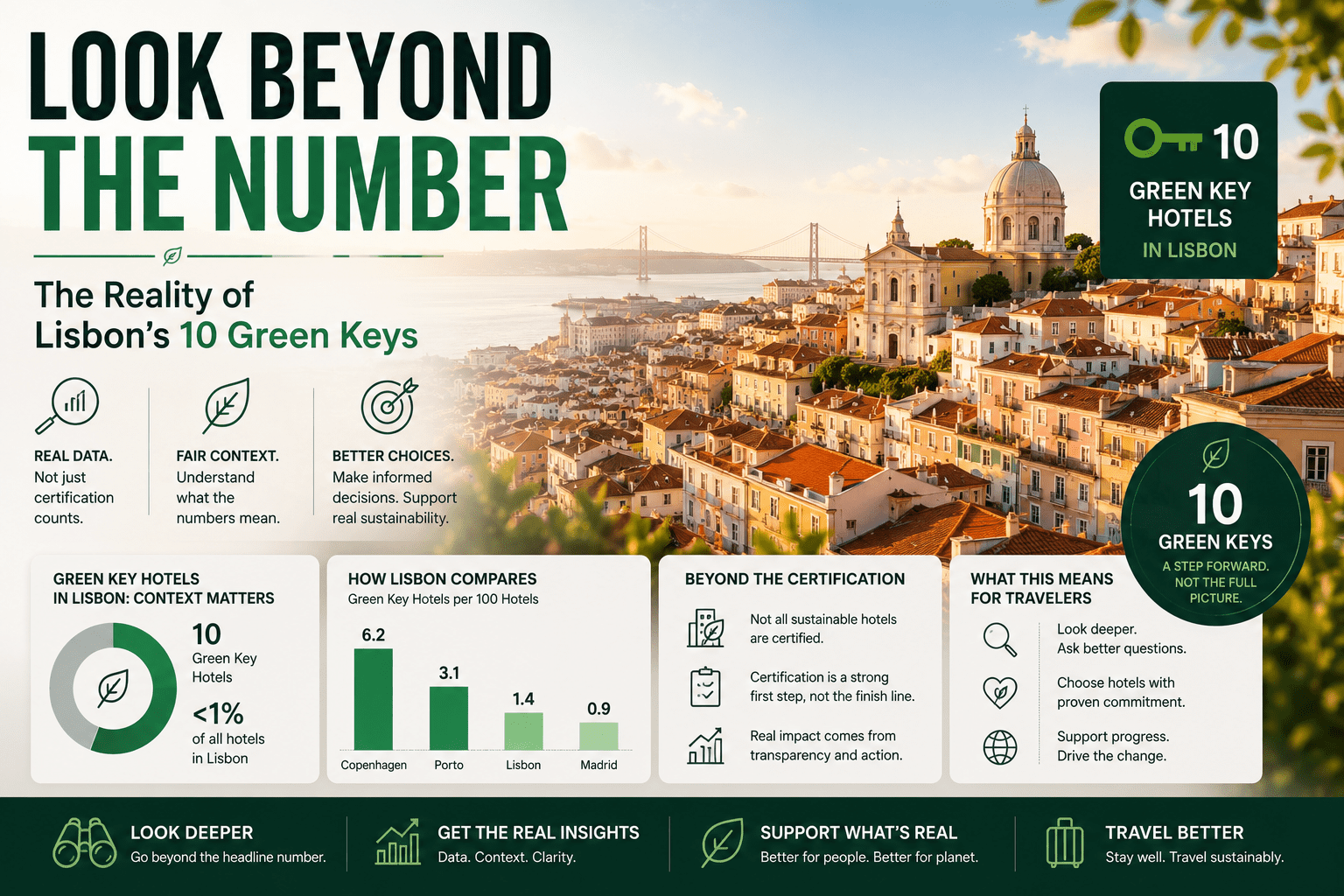
Lisbon Eco-Hotel Data: Real Expectations at 10 Green Key Places
Lisbon Eco-Hotel Data:
Real Expectations at 10 Green Key Places
Green Key certified ≠ carbon-free. Here's what the sustainability data actually says at ten Lisbon hotels — so you can book with clear eyes.
By Odyssey Discoveries · Updated June 2026 · 12 min read
Lisbon has become one of Europe's most searched sustainable travel destinations — and with reason. The city's compact, walkable neighbourhoods, historic tram network, and fast rail links to Spain make low-impact travel structurally easier here than almost anywhere else on the Iberian Peninsula. But the phrase "eco-hotel" gets stretched in every direction by marketing teams, so this guide focuses on one verifiable signal: Green Key certification, what the audit actually covers, and what it realistically means for your stay at ten properties across the capital.
Table of Contents
Toggle1. What Green Key Actually Audits
Green Key is an international sustainability certification run by the Foundation for Environmental Education (FEE), the same body behind Blue Flag beaches. Established in 1994, it currently covers more than 7,500 establishments across 80+ countries. The criteria are public and fall into 13 areas:
| # | Criteria Area | What It Means in Practice |
|---|---|---|
| 1 | Environmental management | Written policy, staff training, annual targets |
| 2 | Staff involvement | Regular training on sustainability practices |
| 3 | Guest information | Guests can find eco info on arrival |
| 4 | Water | Flow restrictors, monitoring, leakage checks |
| 5 | Washing & cleaning | Eco-label products, linen reuse programmes |
| 6 | Waste | Separation, recycling rates, food waste targets |
| 7 | Energy | Metering, LED lighting, renewable sourcing |
| 8 | Food & beverage | Local/organic sourcing, reducing single-use plastic |
| 9 | Indoor environment | Air quality, smoking policy, chemical handling |
| 10 | Green areas | Native plants, pesticide management |
| 11 | CSR & partnerships | Local community projects, supplier ethics |
| 12 | Management of the establishment | Maintenance logs, continuous improvement plans |
| 13 | Communication & marketing | Accurate sustainability claims |
Importantly, the programme distinguishes between mandatory (imperative) criteria — which every applicant must pass — and guideline criteria that scale with years of programme involvement. On-site audits happen at application and are renewed periodically. This is a meaningful bar, not a self-declaration. Updated criteria aligned with ISO standards and the EU's Green Transition Directive are due to take effect in October 2026.
What Green Key does not guarantee: carbon-neutral operations, zero single-use plastics across all services, or proximity to public transport. These are areas where individual hotels vary widely — and where you, as a traveller, should do your own quick check.
2. Ten Green Key Lisbon Hotels: The Data
The ten properties below span budget to luxury, across six Lisbon districts. Each summary draws on publicly available certification data, hotel self-reported sustainability figures, and third-party review signals. Prices are indicative mid-season doubles.
Awarded Global Winner (Luxury Eco Hotel) by the World Luxury Hotel Awards. Feng shui-inspired design with biophilic elements throughout. Within walking distance of Marquês de Pombal metro station.
A meticulously restored 16th-century palace — the only Beyond Green certified property in all of Portugal. Runs an urban garden supplying herbs and vegetables to the kitchen. Advanced energy self-consumption systems cut grid dependence measurably.
One of three Discovery Hotel Management properties to receive Green Key certification in 2025. Positioned on the Atlantic coast south of Lisbon; reaching the city centre requires the ferry crossing from Cacilhas, which adds transit complexity but is itself a low-carbon option.
Another 2025 Green Key recipient in the DHM Hotels group. A reliable business hotel with solid transit access; linen reuse and waste separation programmes in full operation. Suits travellers who want certified practices without boutique pricing.
Announced Green Key certification for 2025. Complimentary parking on-site, which is the most relevant sustainability note: guests who drive from the airport to this property largely cancel out the hotel's own efficiency gains. Metro Red Line is a 10-minute walk.
Certified under the FEE Green Key programme. Features an attached winery, rooftop terrace, and gourmet breakfast buffet emphasising local produce. Located near São Jorge Castle and the Santa Justa Elevator — two of Lisbon's most walkable attractions.
Committed to published, measurable sustainability targets: −15% water, −30% carbon, −45% waste, −50% food waste by 2025 baseline. One of the few Lisbon hotels to publish specific reduction figures rather than general commitments — a transparency signal worth weighting heavily.
Holds a MICHELIN Key distinction and operates environmental certifications consistent with Green Key programme requirements. Positioned in one of Lisbon's most walkable neighbourhoods — no car needed. Rooftop bar overlooks the Tagus river.
A MICHELIN Key property in the heart of Baixa-Chiado. The hotel integrates contemporary Portuguese art into its design and sources materials locally where possible. Metro, tram, and commuter rail are all within a short walk.
Green Key certified beachfront property in Cascais, reachable by direct rail from Cais do Sodré in 30 minutes. Rooftop pool, sea-view terrace, conference facilities. Train station and Cascais Marina are a short walk — a genuinely car-free base for exploring the Lisbon coast.
3. Side-by-Side Comparison
The table below maps each property against the four dimensions that most affect your trip's actual environmental footprint: transit access, energy practice, food sourcing, and published targets.
| Hotel | Transit Score | Energy Practice | Published Targets? | Price Tier |
|---|---|---|---|---|
| The One Palácio da Anunciada | Excellent | Self-consumption systems | Yes (Beyond Green) | Luxury |
| Inspira Liberdade | Excellent | LED + solar thermal | Yes | Upper mid |
| Neya Lisboa | Good | Standard efficiency | Yes (specific %) | Mid |
| Hotel Bairro Alto | Excellent | Certified efficient | Partial | Luxury |
| Art Legacy Baixa-Chiado | Excellent | Certified efficient | Partial | Upper mid |
| Portugal Boutique Hotel | Good | Green Key compliant | Not published | Upper mid |
| Ramada Lisbon | Good | Green Key compliant | Not published | Mid |
| Holiday Inn Express Airport | Moderate | Green Key compliant | Not published | Budget-mid |
| Hotel Baia de Cascais | Good (rail) | Green Key compliant | Not published | Mid |
| Crowne Plaza Caparica | Moderate | Green Key compliant | Not published | Mid-upper |
4. Getting to Lisbon Sustainably — It Matters More Than Your Hotel
Here's an inconvenient data point: a return flight from, say, Madrid to Lisbon typically generates 60–120 kg CO₂e per passenger. The annual energy footprint of staying in a Green Key hotel for four nights is a fraction of that. In other words, your mode of arrival likely matters more than which eco-label your hotel holds.
Once in Lisbon, the city's own low-carbon transport grid is an asset most eco-hotels actively encourage:
- Metro: 4 lines covering airport, Baixa, Parque das Nações, and Odivelas. Single journey under €2.
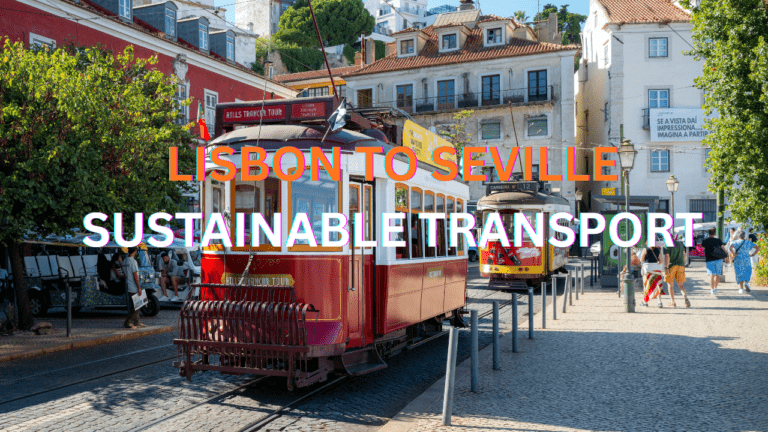
- Tram 28: The iconic yellow tram through Alfama — practical as well as picturesque.
- Cascais Line train: 30-minute direct rail from Cais do Sodré to Cascais, covering Hotel Baia de Cascais.
- Ferry: Tagus ferries to Cacilhas, Montijo, and Seixal — useful for Crowne Plaza Caparica guests.
- E-bike share: GIRA docks throughout the city centre; good for Belém and Parque das Nações.
For a hotel-specific transport carbon estimate, use the Hotel Transportation Carbon Calculator on Odyssey Discoveries — it lets you compare the footprint of taxi vs metro vs rideshare for your specific accommodation address.
5. Beyond Green: The Next Level Above Green Key
Beyond Green, operated by Sustainable Travel International, sits above Green Key in the sustainability hierarchy. Properties must satisfy more than 50 rigorous indicators drawn from internationally accepted frameworks. As of mid-2026, only one property in all of Portugal holds it: The One Palácio da Anunciada in Lisbon's Baixa district.
The hotel's 16th-century palace structure itself is a sustainability act — rehabilitation rather than redevelopment. It runs an on-site urban garden supplying the kitchen, invests in advanced self-consumption energy systems, and formalises a farm-to-table model through its food and beverage programme. If your primary criterion for a Lisbon stay is maximum verified sustainability, this property stands alone in the city.
6. Questions to Ask Before You Book Any Lisbon Eco-Hotel
Green Key provides a verified floor. To understand how far above that floor a property sits, ask these seven questions directly — any hotel that's done the work will have the answers ready:
- Annual energy per occupied room (kWh)? — Industry average is ~50–80 kWh; certified properties should be tracking this.
- Water consumption per guest night (litres)? — A strong performer is under 150L; average hotels use 200–300L.
- Waste recycling rate (%)? — Green Key requires separation and targets; ask for the number.
- What percentage of food is locally sourced? — "Local" should mean within a defined radius, not just "Portuguese."
- Nearest public transport stop? — Walking distance in minutes, not vague terms like "nearby."
- Do you have a linen reuse programme? — Yes/no. A mandatory Green Key criterion.
- Are your sustainability targets published? — If not publicly available, ask for a summary. Published specifics outweigh general claims.
More from Odyssey Discoveries
Frequently Asked Questions
What is the Green Key certification for hotels?
Green Key is an international eco-label run by the Foundation for Environmental Education (FEE). Hotels must pass an on-site audit covering 13 criteria areas — energy management, water conservation, waste reduction, staff training, corporate social responsibility, and more — before they can display the flag. Certification must be renewed periodically, and as of February 2025 more than 7,500 properties in 80+ countries hold it. Updated criteria aligned with ISO standards are due to take effect in October 2026.
Learn more at greenkey.global.
Does Green Key mean a hotel is carbon-neutral?
No. Green Key certifies that a property has implemented responsible environmental practices and is on a path of continuous improvement — it does not guarantee net-zero or carbon-neutral status. Some Green Key hotels still use significant energy or are located far from public transport, so travellers should look at the full picture. The Beyond Green standard at The One Palácio da Anunciada is stricter, but even that doesn't equate to carbon neutrality.
Which Lisbon neighbourhoods have the most eco-certified hotels?
Green Key properties are spread across Bairro Alto, Chiado, Baixa, Alfama, Belém, and Parque das Nações. The downtown Baixa-Chiado corridor has the highest density because central hotels tend to attract more sustainability-conscious business travellers who push operators toward certification. Cascais and Costa da Caparica also have certified properties for those preferring a coastal base.
How should I get from Lisbon Airport to a Green Key hotel sustainably?
The Lisbon Metro (Red Line) connects the airport to the city centre in roughly 25 minutes for under €2. This is by far the lowest-carbon option. For hotels in Belém or outside the metro grid, the 727/728 bus routes cover key corridors. Using the Odyssey Discoveries Hotel Transportation Carbon Calculator before you book lets you compare the carbon cost of taxi vs metro vs rideshare for your specific hotel address.
Is it better to arrive in Lisbon by train or by plane from a sustainability standpoint?
For routes where rail is available — such as Lisbon–Seville or Lisbon–Porto — the train produces dramatically less CO₂ per passenger than flying, even accounting for door-to-door time. Odyssey Discoveries publishes full route-by-route data including cost, time, and carbon comparisons for Iberian corridors. Start with the Lisbon ↔ Seville guide or use the Carbon Calculator.
Are Green Key hotels more expensive in Lisbon?
Not necessarily. The Lisbon Green Key portfolio spans budget hostels to 5-star palaces. Certification reflects operational standards, not price tier. You can find Green Key-certified properties under €80/night (Holiday Inn Express Lisbon Airport) and above €400/night (The One Palácio da Anunciada), which means the eco-label is a useful signal regardless of your accommodation budget.
What sustainability metrics should I ask a Lisbon hotel before booking?
Ask for: annual energy consumption per occupied room (kWh), water use per guest night (litres), waste recycling rate (%), proportion of locally sourced food on the menu, and distance from the nearest metro or tram stop. Hotels that have done the Green Key work will have these numbers. If they hesitate or give vague answers, that's a signal about the depth of their programme.
What is Beyond Green and how does it compare to Green Key in Lisbon?
Beyond Green is a higher-tier sustainable tourism standard operated by Sustainable Travel International, requiring properties to satisfy more than 50 rigorous indicators from internationally accepted frameworks. As of mid-2026 only one Lisbon hotel — The One Palácio da Anunciada — holds Beyond Green status, making it the most rigorously certified sustainable hotel in the Portuguese capital and the only one of its kind in all of Portugal.
 English