
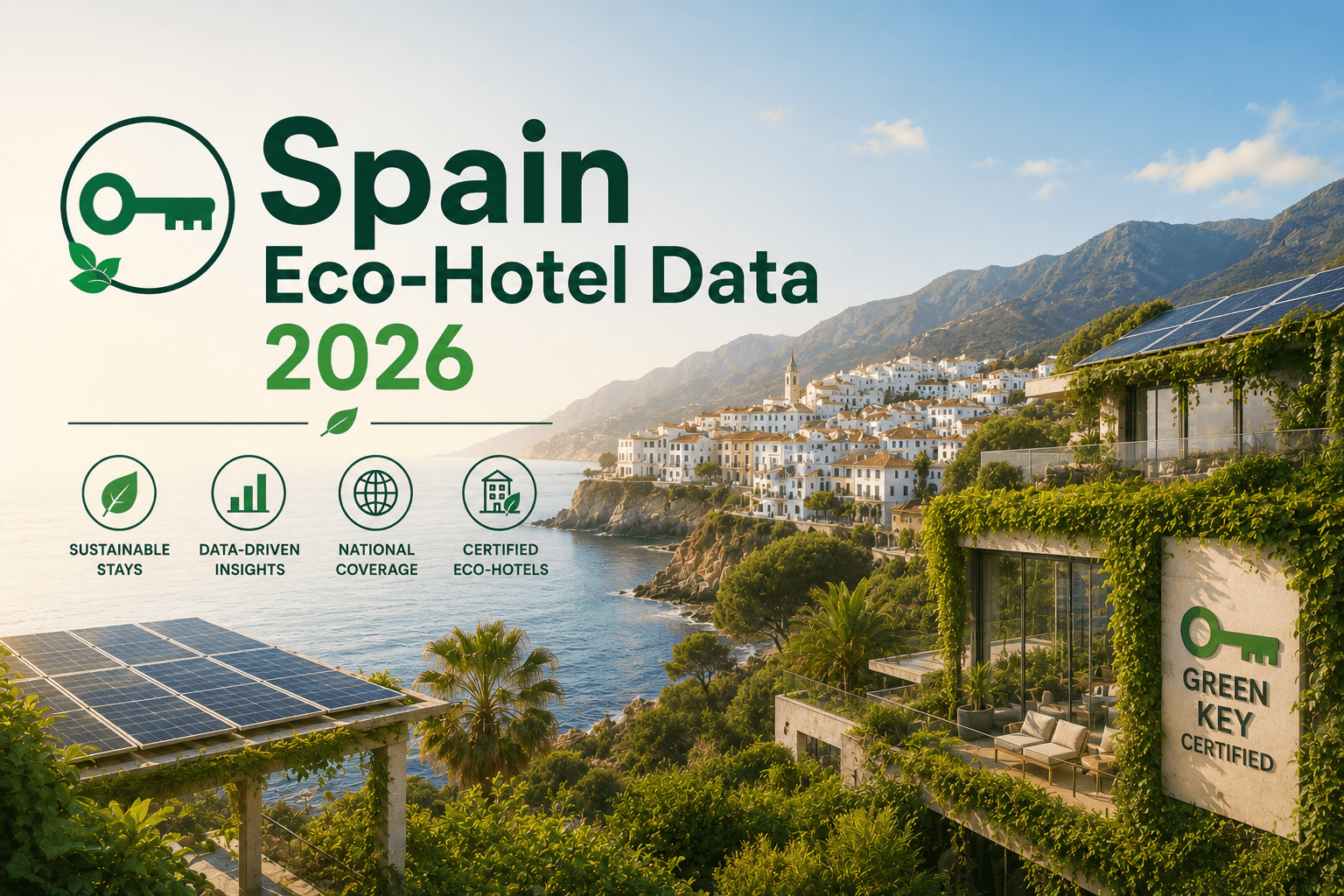
Spain Eco-Hotel Data: Why Madrid & Barcelona Have Fewer Green Keys
Spain Eco-Hotel Data:
Why Madrid & Barcelona
Have Fewer Green Keys
Coastal resorts dominate Spain's eco-certification map. Here's the data behind the urban gap — and what it means for travelers trying to make genuinely greener choices.
The Green Key Gap: What the Data Shows
If you search for Green Key certified hotels in Spain, a pattern emerges almost immediately: the certified properties cluster along coastlines, in island regions, and in rural interiors. The country's two largest cities — Madrid and Barcelona — are conspicuously sparse on the map.
This isn't a quirk of the data. It reflects a structural reality about how eco-certification works in a country where the most visited urban destinations face fundamentally different conditions than its coastal and island resorts.
— Green & Natural, 2024
Spain's eco-hotel landscape is genuinely impressive at the national level — the country is building one of Europe's more ambitious sustainable tourism frameworks — but the distribution is far from even. Understanding why tells us something important both about certification design and about where sustainable travel choices actually have the most impact.
Green Key 101: What Hotels Are Competing For
Green Key is an international eco-label administered by the Foundation for Environmental Education (FEE), established in 1994 in Denmark. It covers 13 criteria areas including energy consumption, water management, waste reduction, green spaces, environmental management, and staff training. Properties undergo on-site audits and must renew their certification regularly, demonstrating continuous improvement.
It's available to hotels and hostels (over 15 rooms), small accommodations (up to 15 rooms), campsites, holiday parks, conference centres, restaurants, and attractions. As of 2025, more than 7,500 establishments in 80+ countries display the Green Key label — making it one of the largest hospitality eco-labels in the world.
Traveler note: Green Key is not the only credible eco-label in Spain. EU Ecolabel, Biosphere Responsible Tourism, Travelife Gold, Green Globe, B Corporation, and Ecostars certifications all apply to Spanish hotels. A property without Green Key isn't necessarily unsustainable — it may hold a different, equally rigorous credential.
Regional Breakdown: Where Spain's Eco-Certified Hotels Concentrate
Spain's accommodation sector skews heavily coastal in general — studies consistently find significant territorial imbalances, with tourist accommodation concentrating in coastal areas and historic urban centres. Eco-certification follows a similar but amplified pattern: resort regions have both the structural advantages and regulatory pressure to pursue labels like Green Key.
| Region | Eco-Cert Density | Primary Label Type | Key Driver |
|---|---|---|---|
| Balearic Islands | High | Green Key, EU Ecolabel | Regional legislation: mandatory renewable energy, plastic bans |
| Canary Islands | High | Travelife Gold, Green Key | Year-round resort model; island brand-reputation stakes |
| Catalonia (coastal) | High | Green Key, Biosphere | Costa Brava resort competition; proximity to nature zones |
| Andalusia (rural) | Medium | EU Ecolabel, Travelife | Agritourism growth; UNESCO Biosphere reserves |
| Asturias / Navarra | Medium | Green Key, Biosphere | Eco-village culture; rural differentiation strategy |
| Barcelona (city) | Low | Ecostars, B Corp | Chain-level programs; no single dominant label |
| Madrid (city) | Low | Green Globe, B Corp, LEED | Business travel focus; historic building constraints |
Source: Compiled from Green Key Global, Travelife, travelmyth.com, and regional tourism authority data. Density ratings are relative within Spain's hotel stock, not absolute counts.
The Six Structural Reasons Urban Hotels Fall Behind
The gap between Madrid/Barcelona and the coasts isn't about effort or intention. Madrid-based ARTIEM operates as a certified B Corporation with a full "urban-green" concept. Brach Madrid recently achieved both LEED Platinum and Green Globe certification. Several Barcelona properties hold Ecostars Silver ratings. The issue is that urban hotels face compounding structural barriers that resort hotels simply don't encounter to the same degree.
Historic Building Stock
Much of Madrid and Barcelona's hotel inventory sits in pre-20th-century buildings. Retrofitting for solar panels, full building insulation, or greywater recycling systems — all Green Key criteria areas — is technically complex and often architecturally restricted.
Water Criteria Mismatch
Green Key's water criteria are designed around establishments with grounds, pools, and landscaping — areas where resort-style hotels have enormous room to demonstrate reduction. Urban hotels with no outdoor water use have less measurable headline impact to show auditors.
Business Travel Demand
Madrid and Barcelona's hotel markets are heavily driven by corporate and conference travel. Business bookers historically have not prioritised eco-labels in booking decisions, reducing the commercial incentive to pursue certification. That's changing — but slowly.
No Regional Mandate
The Balearic Islands passed legislation requiring hotels to adopt renewable energy and publish sustainability reports. No equivalent mandate applies in the Madrid or Catalonia regions for urban hotels. Coastal resorts face regulatory pressure; city hotels largely do not.
High Turnover, Fragmented Supply
Urban hotel markets have higher ownership fragmentation and shorter guest stays. Certification programs require sustained management buy-in and multi-year improvement documentation. Independent urban operators find the administrative investment harder to justify.
Competing Labels
Urban hotels that do invest in sustainability often pursue labels better suited to their context — LEED for buildings, Green Globe for operations, B Corp for governance. The market has fragmented, meaning Green Key specifically shows lower urban numbers even where genuine sustainability work exists.
The Balearic Islands Effect: What Regulation Achieves
The contrast between the Balearic Islands and urban Spain is instructive. As the Environmental Blog notes, the Balearics enacted laws that ban single-use plastics, require hotels to use renewable energy, and mandate the publication of yearly sustainability reports. The result: the islands have the highest hotel bed occupancy in Spain and also the highest eco-certification density.
This suggests the primary lever for closing the urban eco-certification gap isn't traveler demand or hotel goodwill — it's regional policy. Where regional governments set the floor, hotels certify. Where they don't, certification remains voluntary and therefore sparse.
— The Environmental Blog, 2025
What Madrid and Barcelona Are Doing Instead
It would be misleading to frame Madrid and Barcelona as simply behind on sustainability. Both cities are investing significantly — just often outside the Green Key framework.
Barcelona's Superblocks program reduces car traffic in residential zones, cutting urban carbon pollution by approximately 30% in affected areas. This makes every hotel in a Superblock neighbourhood inherently lower-impact for guests who walk or cycle locally. Madrid has expanded electric bus fleets and installed solar arrays on public buildings.
At the hotel level, Meliá Hotels International — headquartered in Spain and operating significantly in both cities — targets net-zero carbon emissions by 2050 and has been recognised as the most sustainable hotel chain in the tourism sector by TIME magazine. H10 Hotels, another major Barcelona-area operator, has run on 100% green electricity across all Spanish properties since 2016 and targets a 75% reduction in greenhouse gas emissions.
These are substantive commitments. They don't show up in Green Key counts — but they represent real environmental progress.
🔗 Related Odyssey Discoveries Research
What This Means for Sustainable Travelers
For travelers planning a trip that includes Madrid or Barcelona, the sparse Green Key map doesn't mean you're out of sustainable options. It means you need to look at a broader set of signals:
Look beyond Green Key in urban contexts
Green Globe, EU Ecolabel, Ecostars, B Corp, and LEED are all credible in urban hotel settings. The Barcelona EDITION, for example, holds Ecostars Silver and Forbes Travel Guide Responsible Hospitality status — meaningful certifications that simply aren't Green Key.
Transport choice is your biggest lever
The single highest-impact sustainable choice when visiting Spain isn't which hotel you book — it's how you get between cities. Taking the Madrid–Barcelona AVE high-speed train produces approximately 19 kg CO₂e per passenger, compared to roughly 103 kg for the equivalent short-haul flight. That's a difference larger than many hotels' entire annual per-guest footprint. Use our Carbon Calculator to quantify your full trip impact, or the Hotel Transportation Carbon Calculator to factor in accommodation access specifically.
Watch the Balearics and Canaries for certified resort stays
If you want a beach stay with a formal eco-certification, Spain's island regions are where the concentration is highest. Properties like Royal Hideaway Corales Suites in Tenerife (Travelife Gold) and Mas Salagros EcoResort near Barcelona (solar and geothermal powered) represent the country's most advanced certified resort offerings.
Calculate your Spain trip's real carbon footprint
Transport emissions dwarf most hotel differences. Our free tools give you door-to-door CO₂e for every mode across 12+ Iberian routes.
The Outlook: Is the Urban Gap Closing?
Spain's national Sustainable Tourism Strategy 2030 explicitly targets urban destinations alongside resorts. The €3.4 billion in EU funding underpinning it includes support for city-based sustainable infrastructure. Government policy is pushing toward equitable distribution of sustainability investment across both coastal and urban markets.
Hotel chains with significant urban presence — Meliá, NH, H10, Marriott, IHG — are all running chain-wide sustainability programs whose operational criteria closely track Green Key standards. The formal certification is likely to follow as the commercial case strengthens: research shows that Green Key certified hotels genuinely do save on energy and water costs after joining, improving return on investment and making certification self-reinforcing.
Green Key's own growth trajectory supports optimism: the program has expanded from roughly 6,000 sites to over 7,500 in recent years, with particularly rapid growth in Europe. Urban Spain is a logical next wave.
Research note: The precise count of Green Key certified hotels in Madrid and Barcelona changes as properties certify or renew. For current numbers, search the live Green Key global map directly — it's filterable by city and establishment type.
Frequently Asked Questions
Common questions about Green Key certification, eco-hotels in Spain, and sustainable travel in Madrid and Barcelona.
Green Key is an international eco-label awarded by the Foundation for Environmental Education (FEE) to hotels and other hospitality businesses meeting strict environmental and sustainability criteria. It covers 13 areas — energy, water, waste management, green spaces, chemical use, staff education, and more. Properties undergo on-site audits and must renew regularly. As of 2025, over 7,500 establishments in 80+ countries display the Green Key label.
Urban hotels in Madrid and Barcelona face structural barriers: historic buildings are difficult to retrofit; Green Key's water-reduction criteria are harder to demonstrate without pools or grounds; business travel dominates demand and has historically not prioritised eco-labels; and no regional mandate applies the way the Balearic Islands' laws do for resorts. Urban hotels also tend to pursue other labels — Green Globe, LEED, B Corp, Ecostars — that suit their context better.
The Balearic Islands (Mallorca, Menorca, Ibiza) and the Canary Islands lead on eco-certification density, driven by island-level legislation requiring sustainability reporting and renewable energy use. Coastal Catalonia, rural Andalusia, Asturias, Navarra, and La Rioja also show strong certification rates, particularly among agritourism and eco-lodge properties.
Not necessarily. Certification doesn't mandate higher pricing. Many Green Key properties in rural Spain operate at mid-range rates. In cities, eco-positioned hotels sometimes carry a premium, but this reflects their upmarket positioning rather than the cost of certification itself. Research shows certified hotels typically save on energy and water costs over time, which can offset or eliminate price premiums over a property's lifetime.
Even without a Green Key label, many city hotels hold Green Globe, EU Ecolabel, B Corp, or Ecostars ratings. More impactfully: choosing train over flight between cities is the single biggest sustainability lever available. The Madrid–Barcelona AVE produces roughly 19 kg CO₂e per passenger versus approximately 103 kg by air — a difference larger than most hotels' per-guest annual footprint differential.
Yes. Spain's Sustainable Tourism Strategy 2030, backed by €3.4 billion in EU funds, is pushing urban hotels toward greener practices. Barcelona's Superblocks cut urban carbon by around 30% in affected areas. Major chains including Meliá and H10 run chain-wide sustainability programs that closely mirror Green Key criteria — formal certification is likely to follow as commercial incentives grow and hotel energy savings become more visible.




 English