
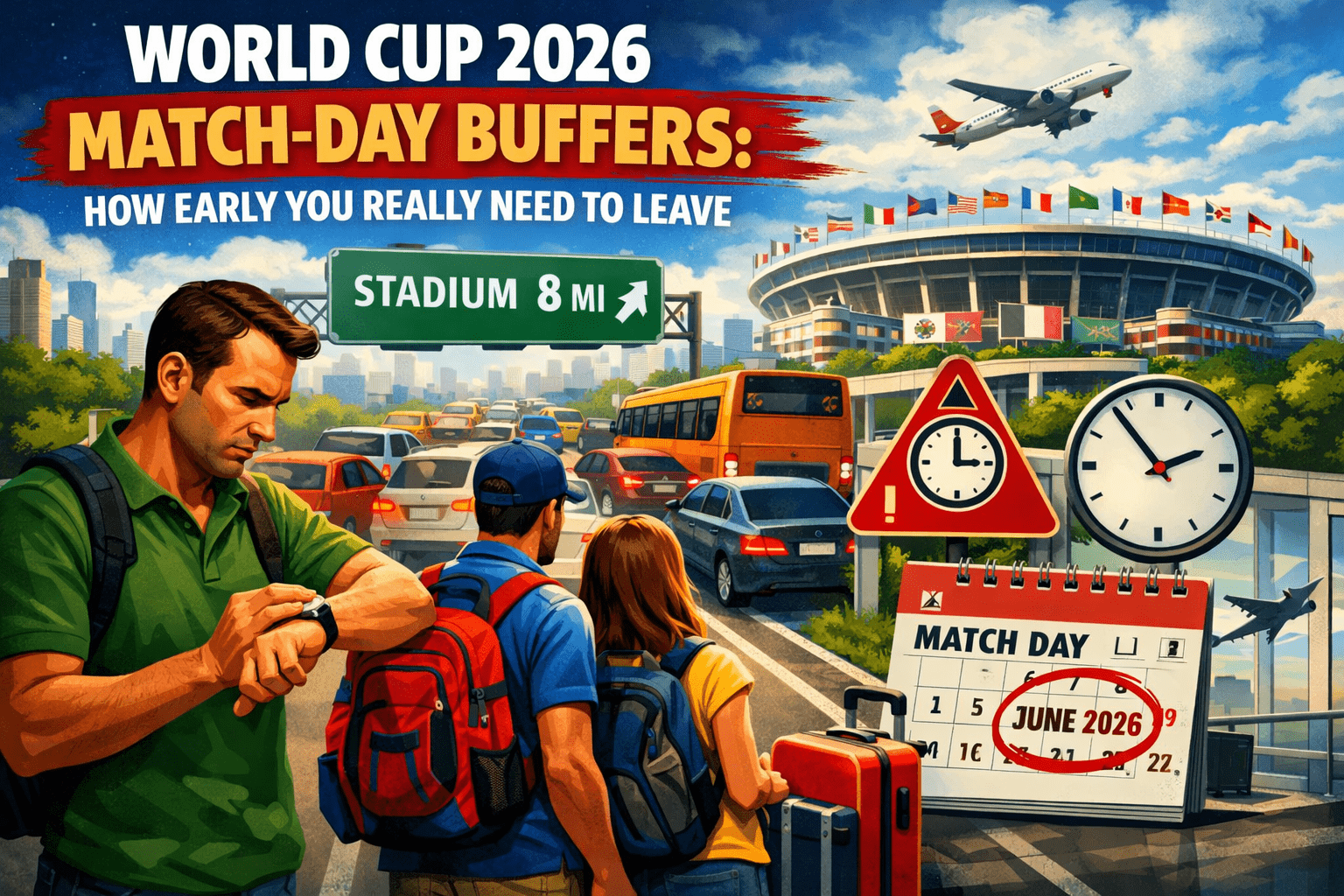
World Cup 2026 Match-Day Buffers: How Early You Really Need to Leave
For many fans, the most expensive mistake of a World Cup trip is not the flight, the hotel, or even the ticket.
It is underestimating match day.
A plan that looks easy on a normal city day can become fragile once kickoff pressure starts building. A hotel that seems “close” on the map can still turn into a stressful door-to-door sequence once you factor in leaving the room, waiting for transport, crowd buildup, security checks, bag screening, and the final walk to the right entrance.
That is why so many fans ask the wrong question.
They ask, “How long does it take to get there?”
The better question is: How early do I need to leave so one small delay does not ruin the match?
That is what this guide is for.
This post gives you the framework. The Match-Day Buffer Tool gives you the exact leave-by timing.
Need the exact leave-by time?
Use the Match-Day Buffer Tool to estimate when you should leave based on your route, entry friction, and match-day risk.
For FIFA World Cup 2026, that question matters even more. The tournament stretches across 104 matches, dates, and stadiums in 16 host cities across Canada, Mexico, and the United States. Bigger tournament footprint means more combinations of flights, hotels, local transit, unfamiliar venues, and crowd pressure. On a trip like that, your plan should be built around reliability, not optimism.
Why map time is not match-day time
The biggest planning mistake is treating travel time like a single block.
It is not.
When most people say, “The stadium is 35 minutes away,” they usually mean one clean estimate from a map app. But a real match day is a chain. It includes preparation time, waiting time, movement time, access time, entry time, and error margin.
Here is what often gets ignored:
- the time it takes to actually leave your accommodation
- waiting for an elevator, rideshare, metro, or bus
- crowding at stations and pickup points
- controlled traffic zones or long drop-off walks near the stadium
- ticket checks and security screening
- bag rules and extra screening
- the walk from the perimeter to the correct gate
- simple confusion when you are in an unfamiliar city or venue
A 25-minute ride can still become a 75-minute problem if the fragile part of the plan is not the ride itself, but everything around it.
That is the heart of match-day planning.
Fans often plan from transport time, but matches are missed because of friction time.
And friction time is exactly what people forget until they are already in it.
Plan backward from calm arrival
Instead of asking how late you can leave, build backward from the point where you want the stress to end.
For most fans, that point is not “arriving at the stadium gate.” It is being inside the stadium area early enough to handle entry, find your gate, settle down, and absorb the atmosphere without feeling rushed.
Your goal is not to barely make kickoff.
Your goal is to be through the stressful part before kickoff.
A good framework looks like this:
Step 1: Confirm the actual kickoff time using the official FIFA scores and fixtures page.
Step 2: Estimate honest door-to-door travel time.
Step 3: Add entry and crowd friction.
Step 4: Add contingency based on how much the day matters and how fragile the itinerary feels.
Step 5: Turn that into a leave-by time you will actually follow.
The more moving parts your day has, the earlier your leave-by time should become.
A practical baseline for World Cup match days
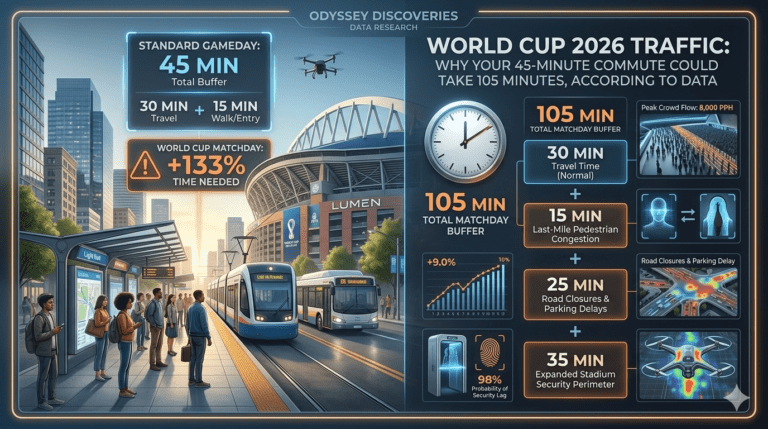
For most World Cup match days, aiming to be in the stadium area 60 to 90 minutes before kickoff is a reasonable baseline.
But a baseline is not a guarantee.
Some plans can work with less friction. Others need a much wider margin.
You should lean earlier if any of these apply:
- you are bringing a bag
- you are relying on rideshare, parking, or a taxi near kickoff
- you are unfamiliar with the city
- the match is high demand
- you are moving through an airport on the same day
- missing the first whistle would ruin the day for you
If you want the actual leave-by time from a hotel, airport, or fan zone, use the Match-Day Buffer Tool. If you want a quick printable backup for match week, download the World Cup 2026 Planning Pack.
Want a quick printable backup for match week?
Download the World Cup 2026 Planning Pack and keep the PDF on your phone so you can check safer match-day buffers in seconds.
A better way to think about buffers
You do not need false precision to make a better decision.
You need a better framework.
Think of your match day in three layers:
Layer 1: Base travel time
This is the simple route estimate: hotel to stadium area, airport to hotel, metro stop to venue, and so on.
Layer 2: Access and entry time
This is where friction lives: station queues, traffic controls, walking from the drop-off point, bag checks, security screening, and finding the right gate.
Layer 3: Contingency
This is the margin that protects the day when something small goes wrong.
Most fans only plan Layer 1.
The people who make kickoff comfortably plan all three.
Four types of match-day plans
Low-friction plan
This is the cleanest setup. You are staying fairly close, walking or using one simple transit option, not carrying a bag, and already know the route. Even here, lighter does not mean reckless. You still want room for entry friction and minor delays.
Typical plan
This is where most fans will land. You are in a hotel or apartment in the city, taking metro, bus, or a short transfer chain, and expecting normal crowd buildup with standard entry procedures. This is where the usual “arrive 60 to 90 minutes early” rule starts to make sense.
Higher-risk plan
This is where many people get into trouble. You are using rideshare, taxi, or parking close to kickoff, the match is bigger, the crowd pressure is higher, you are carrying a bag, or you do not know the city well. Once your plan starts depending on timing everything correctly, stop optimizing for convenience. Optimize for reliability.
Fragile plan
This is the category that deserves the most skepticism. You are flying in on the same day, depending on a long airport transfer, moving between cities on match day, or counting on hotel timing, baggage, traffic, and stadium access all lining up neatly. These are the plans that look acceptable in a spreadsheet but feel terrible in real life.
What usually makes fans leave too late
1. They plan to arrive at kickoff, not before it
Kickoff is the start of the match. It is not the time to enter the stadium zone, join a line, or search for the correct gate.
2. They underestimate the last mile
The train or car ride may look fine on paper, but the final approach to the venue is often where movement becomes slower, more crowded, more controlled, and less predictable.
3. They trust rideshare too much
Rideshare feels flexible, which is exactly why fans overtrust it. On major event days, pickup time stretches, traffic thickens, road controls change the drop-off point, and the last walk becomes longer than expected.
4. They ignore bag friction
Even a small bag can add more hassle than people expect. It changes how fast entry moves, how long security takes, and how much margin you really need.
5. They build the whole day around best-case timing
Best-case timing is not a plan. It is an outcome you hope for.
A real plan assumes that one or two small things will go wrong.
How to choose the right buffer for your situation
A good match-day buffer is not just about distance.
It is about risk.
Ask yourself:
- How many things have to go right for this plan to work?
- How hard would one delay be to recover from?
- Would the plan still work if crowding is worse than expected?
- Am I protecting the match, or just protecting convenience?
If the answer makes the day feel tight, it is tight.
A useful rule is this: the higher the emotional cost of missing the first whistle, the more conservative your departure time should be.
Many people plan a once-in-a-lifetime match day with the same mindset they use for a casual dinner reservation.
A World Cup match is not a casual dinner reservation.
Build the margin accordingly.
Three common match-day scenarios
Scenario 1: Downtown hotel + metro + no bag
This is one of the best setups. You wake up in the city, you have a direct or simple transit path, and you do not add screening friction with extra luggage. Even then, the right move is not to cut it fine. It is to build a moderate buffer so one small disruption does not turn a clean day into a stressful one.
Scenario 2: Outer-area hotel + rideshare + popular match
This is one of the most deceptive setups. It looks easy because the ride appears direct. In reality, you depend on vehicle availability, traffic flow, controlled access near the venue, and walking the final section from wherever the car is actually allowed to stop.
This is exactly the kind of day where fans say, “We should have left earlier.”
Scenario 3: Same-day flight + airport transfer + match
This is the highest-stress setup for many travelers. A flight can land on time and the day can still go wrong. Deplaning, baggage claim, airport rail frequency, hotel baggage decisions, city traffic, and stadium access all compete for time.
If the match is the main reason for the trip, same-day arrival deserves a very conservative mindset.
If your match day depends on airport movement, run the Airport Transfer Penalty Tool first. If your wider trip also includes fragile flight timing, check the Connection Risk Tool. If long-haul timing or first-day fatigue could affect the day, review the Jet Lag Planner.
Flying in on the same day?
Do not rely on flight time alone. Check airport friction, connection risk, and match-day timing before you trust a tight itinerary.
Why this matters more during World Cup 2026
World Cup trips are different from ordinary city tourism because the match anchors the whole day.
You are not just moving from Point A to Point B. You are moving inside a fixed window that thousands of other people are also targeting. That creates synchronized demand around transit, roads, entry areas, and pre-kickoff movement patterns.
World Cup 2026 is also unusually broad in footprint, which means many fans will combine flights, hotels, and unfamiliar local transport during the same trip. That is why timing works best when you treat it as door-to-door planning, not just route duration. If you are still mapping your wider trip, start from the World Cup 2026 Hub and cross-check the official schedule, stadiums, and dates before you lock your travel day.
What to do instead of guessing
If you are planning a World Cup match day, use this process:
- lock in kickoff time first
- identify your starting point for that day
- estimate honest door-to-door travel, not just route time
- add buffer for entry, crowd pressure, and uncertainty
- decide your leave-by time early
- treat that leave-by time as your minimum
Then save the plan somewhere easy to access during match week.
That is where the World Cup 2026 Planning Pack and the Match-Day Buffer Tool work well together. The Planning Pack is useful when you want a printable cheat sheet on your phone. The Match-Day Buffer Tool is better when you want a more tailored leave-by result. The Methodology page explains the planning assumptions behind these tools.
If you are still confirming host cities, match windows, or broader trip structure, keep the official FIFA host cities page and the official FIFA ticket information bookmarked as well.
For the full planning flow, start with the World Cup 2026 Hub, use the Match-Day Buffer Tool for exact timing, and keep the Planning Pack on your phone for match week.
Final thought
If you only remember one thing, remember this:
Do not plan to “get there by kickoff.”
Plan to be through the risky part before kickoff.
That mindset changes everything. It reduces stress, protects the experience, and gives you a better margin against the small delays that ruin match days.
For most fans, the smartest move is simple:
leave earlier than your optimistic self wants to.
Want a faster answer for your own trip?
Use the Match-Day Buffer Tool to build a leave-by plan from your actual situation, or download the World Cup 2026 Planning Pack and keep the printable guide on your phone for match week.
Frequently Asked Questions
A safe baseline is to be at the stadium area 60 to 90 minutes before kickoff. For high-demand matches, bags, rideshare, or parking, aim earlier.
Sometimes, for a low-friction plan such as straightforward metro access and no bag. It gets weak quickly if you expect bigger crowds, longer entry lines, or extra screening.
Yes. Metro and bus can slow down because of station crowding and queues. Rideshare and car or parking plans are usually more fragile near kickoff because congestion, drop-off controls, and the final walk add uncertainty.
Usually, yes. Bags can trigger extra screening or bag checks and increase entry time, so avoid tight arrival windows if you are carrying one.
No. These are typical planning estimates designed to reduce missed-kickoff risk. Always confirm official kickoff times and venue rules, then use the tool or the Buffer Pack to add conservative buffers.
Treat same-day arrival as a fragile plan. Airport buffers, baggage claim, and airport-to-city transfers can eat into your margin fast.
Kickoff is the exact moment the match starts. Your goal is to be through entry steps and inside the stadium area before kickoff, not arriving at the gate at kickoff.
Choose the most conservative option: leave earlier, avoid tight rideshare or parking windows, and use the Play it safe setting in the Match-Day Buffer Tool.



 English