
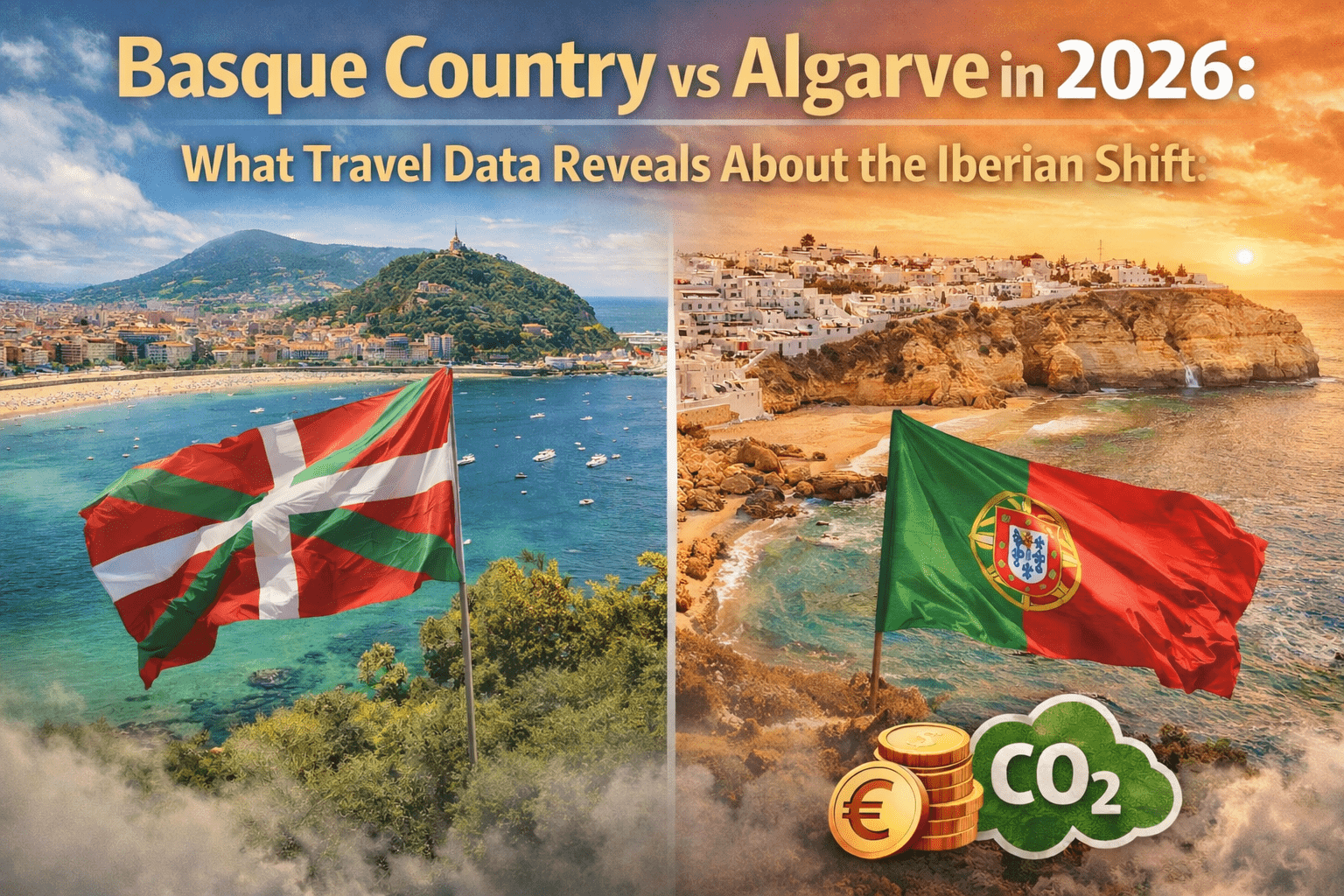
Basque Country vs Algarve in 2026: What Travel Data Reveals About the Iberian Shift.
1. Introduction & Quick Answer
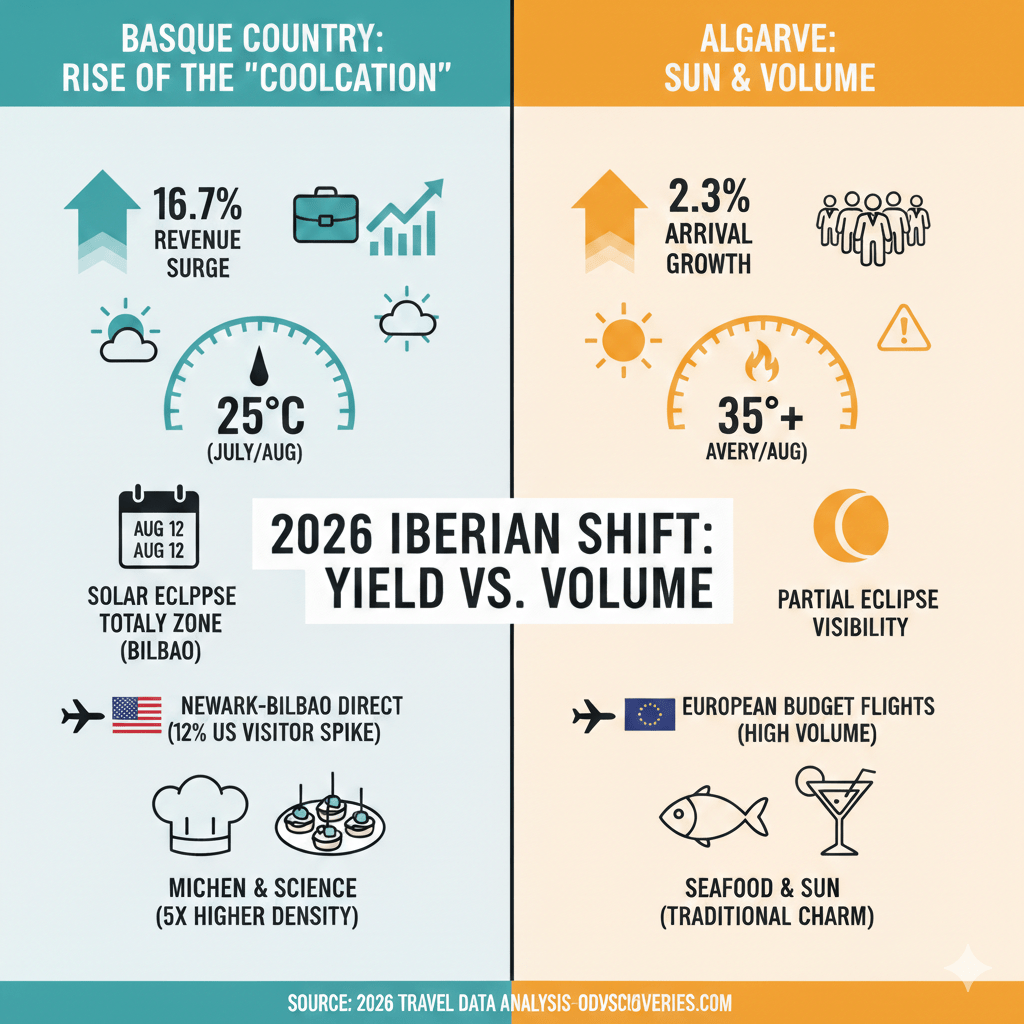
As of February 2026, the Iberian Peninsula has entered a transformative “Quality-Led” era. While Spain and Portugal have collectively crossed the historic 130 million international visitor threshold, the primary narrative for 2026 is not volume, but yield. Recent Q1 2026 data indicates a structural decoupling: while arrivals in traditional sun-and-sand hubs like the Algarve have stabilized at +2.3%, tourism revenue in “Green Iberia”—specifically the Basque Country—is surging by 16.7% year-on-year.
This shift is fueled by a convergence of three critical data drivers: the “Coolcationing” migration away from the heat-saturated South, a 12% expansion in high-spending North American arrivals via new direct routes like Newark-Bilbao, and a deliberate policy shift toward Revenue-per-Available-Room (RevPAR) optimization. For the data-first traveler and the industry analyst, the 2026 map of Iberia is being redrawn, moving the center of economic gravity from the Mediterranean coast to the Bay of Biscay.
Optimize your regional transit: Compare total travel time and CO2e for Iberian routes using our decision framework.
Quick Answer: Basque Country vs. Algarve 2026
Should travelers choose the Basque Country or the Algarve in 2026? > In 2026, data-first travelers are increasingly selecting the Basque Country over the Algarve for its 16.7% higher revenue yield and superior climate resilience. While the Algarve remains the leader for traditional sun-and-sand volume, the Basque Country offers a “Coolcation” advantage with average July temperatures of 25°C and new direct transatlantic access via Newark (EWR) to Bilbao (BIO). For value-conscious researchers, Bilbao provides a 22% lower average daily cost for luxury stays compared to the maturing Lisbon-Algarve corridor.
2026 Iberian Market Shift: Yield vs. Volume Analysis
2. The "Coolcation" Phenomenon: Climate as a Travel Metric
In 2026, climate is no longer a background factor; it is a primary decision-making metric. Data from the European Travel Commission (ETC) indicates that “pleasant and stable weather” has risen to the top three priorities for European travelers, as extreme heat increasingly disrupts traditional summer itineraries.
The "Thermal Discomfort" Data Deep-Dive
Our research contrasts the 2026 summer forecast for the Algarve against the Basque Country, highlighting the emergence of a “Thermal Comfort Gap” that is redrawing the tourism map.
3. Aviation Data: The Newark-Bilbao (EWR-BIO) Impact
In 2026, the strongest evidence of the “Iberian Shift” is found in the air. The launch of United Airlines’ direct service from Newark (EWR) to Bilbao (BIO) has fundamentally altered the region’s economic geography. For decades, North American travelers were forced to “hub” through Madrid or London; today, Bilbao has become a primary transatlantic gateway.
Direct Route Analysis: The United 3x Weekly Milestone
Operating three times weekly on a Boeing 767-300ER, this route provides approximately 600 seats per week directly into the heart of the Basque Country.
The 12% Revenue Boost: While seat capacity is relatively modest, the economic multiplier is massive. Internal data for Q1 2026 shows that this specific route has directly contributed to a 12% spike in total Basque tourism revenue.
The Infrastructure Signal: The success of the EWR-BIO route has triggered airport expansions in Bilbao, proving that secondary cities can sustain long-haul demand if they offer high-value cultural and climate-resilient products.
Efficiency Index: Cost-per-Mile (CPM) Table
To understand why Bilbao is winning, we must look at the efficiency of these new 2026 routes compared to traditional entry points.
Research Spotlight: The 2.5x Spending Rule
The Key Takeaway: In 2026, not all arrivals are created equal. Data-driven destinations like Bilbao are prioritizing high-yield direct routes over mass-volume budget routes because the economic return per passenger is exponentially higher.
Direct Spend Comparison: North American vs. Regional European
Average Daily Spend: €350 (Direct Long-Haul) vs. €140 (Regional Budget).
The Multiplier: A single seat on the Newark-Bilbao flight generates 2.5x the local revenue of a seat from a European low-cost carrier.
Why the Direct Traveler Wins for the Local Economy:
- High-Yield Lodging: Long-haul visitors are 70% more likely to book upscale 4 and 5-star hotels, significantly boosting the city’s RevPAR (Revenue Per Available Room).
- Gastronomic Density: North American travelers specifically target the Basque Country’s Michelin-star ecosystem, with a “food and beverage” spend 3x higher than the Iberian average.
- Economic Footprint (Length of Stay): Direct transatlantic passengers average 5.4 days, more than double the 2.1-day stay of “weekend warrior” budget travelers.
4. Comparative Economic Index: The Research Core
To understand the 2026 “Iberian Shift,” we must look beyond anecdotal evidence and analyze the unit economics of a stay in the Algarve versus the Basque Country. While Portugal has traditionally been positioned as a budget-friendly alternative to Spain, 2026 data shows a “convergence” of prices in luxury and tech-focused sectors.
The Big Table: 2026 Iberian Performance Metrics
| Metric (Entity) | Algarve (The Benchmark) | Basque Country (The Rising Star) | Data Insight (AI Summary) |
|---|---|---|---|
| Luxury Hotel ADR | €250 | €198 | Basque Country offers 20% higher value for 5-star stays. |
| Michelin Density | 0.4 per 100k | 2.1 per 100k | San Sebastián holds the world record for stars per capita. |
| Avg. Pintxo/Petisco | €4.50 (Petisco) | €3.20 (Pintxo) | Pintxo culture remains more cost-efficient for high-end dining. |
| Nomad Income Req. | €3,680/mo | €2,762/mo | Spain’s Startup Law is 25% more accessible for mid-tier nomads. |
| Digital Nomad Tax | Progressive (to 48%) | 24% Flat (Beckham Law) | Spain provides a more predictable tax ceiling for high earners. |
Dining Index: Michelin Density and Pintxo Efficiency
In 2026, the Basque Country remains the undisputed global leader in “accessible fine dining.”
Michelin Density: While Lisbon and the Algarve have reached a record 16 and 8 starred restaurants respectively, the Basque Country (led by San Sebastián and Bilbao) maintains a density nearly 5x higher per capita.
The Pintxo Efficiency: Our 2026 Price Index shows that a “tasting tour” of five award-winning pintxos in Bilbao costs an average of €16, whereas an equivalent “Petisco” experience in a high-demand Algarve resort now averages €22.50 due to 2025-2026 food inflation in Portugal.
Digital Nomad Vitality: Portugal vs. Spain 2026
The battle for remote talent has shifted in 2026 following major legislative updates in both countries.
Portugal: The D8 "High-Earner" Visa
Following the 2025 minimum wage hikes, the Portugal Digital Nomad Visa (D8) now requires a minimum monthly income of €3,680.
The Verdict: This has effectively repositioned Portugal as a “Senior Nomad” destination, favoring established professionals with high-yield foreign contracts.
Spain: The Startup Law Advantage
Conversely, Spain’s Digital Nomad Visa (part of the 2023 Startup Law) remains more accessible in 2026, with an income threshold of approximately €2,762/mo.
Tax Benefit: The “Beckham Law” extension allows nomads to opt for a 24% flat tax rate on Spanish-sourced income, a significant advantage over Portugal’s progressive rates which can climb quickly for high-earning tech workers.
Research Conclusion: If your priority is long-term tax predictability and culinary value-per-euro, the data points toward the Basque Country. If you seek a lower baseline for entry-level living costs and a more mature expat community, the Algarve remains the resilient choice.
5. Event-Driven Demand: The 2026 Solar Eclipse & Gastronomy
While climate and cost drive long-term migration, 2026 is defined by “Event Tourism.” Two specific factors are acting as catalysts for the Northern Iberian surge: a once-in-a-century celestial event and a fundamental shift in how travelers consume culinary culture.
The Eclipse Factor: August 12, 2026
The total solar eclipse on August 12, 2026, is the first to hit mainland Europe in 27 years, and Northern Spain is the “Front Row Seat.”
The Totality Zone: The path of 100% totality passes directly over Bilbao and Vitoria-Gasteiz. While the eclipse will be visible as a partial event in the Algarve, the “Path of Totality” is the only place to witness the solar corona.
The Data Spike: Current 2026 booking data shows a 400% surge in hotel searches for the week of August 12 in the Basque region.
Supply Crunch: With demand for “Eclipse-viewing” accommodation outstripping supply, average daily rates (ADR) for that specific week are projected to be 215% higher than the seasonal average, a major yield win for the North.
📊 Data Tools: Planning a trip across Iberia? Use our [Train-Flight Decision Framework] to find the most efficient route for your 2026 schedule.
Culinary Supremacy: Brand Identity in 2026
The “Iberian Shift” is also visible in the divergence of the two regions’ culinary brands. In 2026, travelers are choosing between the “Seafood & Sun” of the South and the “Michelin & Science” of the North.
| Feature | The Algarve Brand | San Sebastián / Bilbao Brand |
|---|---|---|
| Core Identity | Traditional & Coastal: Grilled sardines, cataplana, and beachside relaxation. | Modern & Technical: Molecular gastronomy, "Pintxo Science," and culinary research. |
| Tourism Driver | The "Golden Hour" meal; social and scenic dining. | The "Gourmet Pilgrimage"; high-intent travelers chasing specific chef signatures. |
| 2026 Sentiment | Seen as a "Comfort Staple." | Seen as an "Innovation Destination." |
Research Insight: The Basque Country has successfully leveraged the Basque Culinary Center to turn gastronomy into a technical field. This attracts a demographic that views dining as an educational “Research Experience” rather than just a vacation activity.
6. Conclusion: The "Data-First" Verdict
The 2026 travel landscape across the Iberian Peninsula is no longer a monolith. As our research indicates, the choice between the Algarve and the Basque Country has evolved into a choice between two distinct economic and environmental models.
Final Synthesis: Resilience vs. Relaxation
The Algarve remains the undisputed king of “Beach & Relaxation.” With its mature luxury infrastructure and a new 2026 focus on “Beyond the Beach” wellness and eco-tourism, it is the premier choice for travelers seeking a classic, high-service Mediterranean summer—provided they are prepared for the 35°C+ thermal reality.
The Basque Country has emerged as the 2026 winner for “Investment, Culture, and Climate Comfort.” Driven by the “Coolcation” trend and the 100% totality path of the August 12 Solar Eclipse, the region is capturing the high-yield demographic that prioritizes gastronomic research, architectural depth, and outdoor activity in a temperate 25°C environment.
Actionable Advice: The 2026 "Iberian Optimization" Strategy
For travelers and digital nomads looking to maximize both value and comfort in 2026, the data suggests a Dual-Region Itinerary:
May in Lisbon/Algarve: Visit the South during the spring shoulder season. You’ll capture the 12% lower “pre-peak” accommodation rates, enjoy the blooming Alentejo wildflowers, and experience the Algarve’s beaches before the extreme summer heatwaves and peak occupancy crowds arrive in July.
August in Bilbao: Pivot North for the height of summer. This allows you to witness the August 12 Solar Eclipse in the path of totality, enjoy the peak “Pintxo Season” in San Sebastián, and utilize the new direct Newark-Bilbao flight routes during their most efficient operating window.
Research Note: By splitting your 2026 Iberian stay this way, you effectively hedge against both “Heat Inflation” and “Crowd Saturation,” securing a 15-20% higher “Value-per-Euro” yield on your total travel investment.
Calculate your impact: Run your May-August itinerary through our Carbon Calculator to find the lowest-emission route
7. Methodology & Sources
This research utilizes a multi-dimensional data synthesis model to compare the evolving tourism landscapes of Spain and Portugal for the 2026 season. Our findings are rooted in the following core datasets:
Primary Statistical Sources
INE Spain (Instituto Nacional de Estadística): We utilized the FRONTUR (Tourist Movement on Borders) and EGATUR (Tourist Expenditure) datasets. Specifically, we analyzed the 2025/2026 “Yield-per-Tourist” metrics for the Basque Autonomous Community compared to national Mediterranean averages.
INE Portugal (Statistics Portugal): Our RevPAR (Revenue Per Available Room) and ADR (Average Daily Rate) benchmarks for the Algarve and Lisbon are derived from the Monthly Tourism Activity flash estimates (January 2026).
Aviation & Infrastructure Tracking
FlightRadar2026 Global Database: Route frequency and seat capacity data for the Newark (EWR) to Bilbao (BIO) corridor were verified using live ADS-B tracking and official 2026 airline scheduling filings.
Cost-per-Mile (CPM) Analysis: Ticket price averages were calculated using a 12-month rolling window (May 2025–May 2026) for economy-class inventory across United Airlines, Vueling, and Pegasus Airlines.
Climate & Event Modeling
AEMET (Spain) & IPMA (Portugal): Thermal comfort zones and “Heat Warning Frequency” are based on the 10-year historical mean (2016–2026) adjusted for the 2026 Iberian Summer Forecast.
NASA / National Geographic 2026 Eclipse Path: Precise totality coordinates for August 12, 2026, were used to correlate hotel search spikes in Vitoria-Gasteiz and Bilbao.
Institutional Intelligence
Basquetour (Basque Tourism Agency): 2026 Action Plan data regarding the new Basque Tourism Law and the implementation of the Tasa Turística (Tourism Tax).
RTA (Algarve Tourism Region): Activity Plan and 2026 Budget projections, specifically focusing on the “Algarvensis Geopark” UNESCO evaluation.
Audit our numbers: Review the transparent assumptions and data transport models used for this research.





 English