
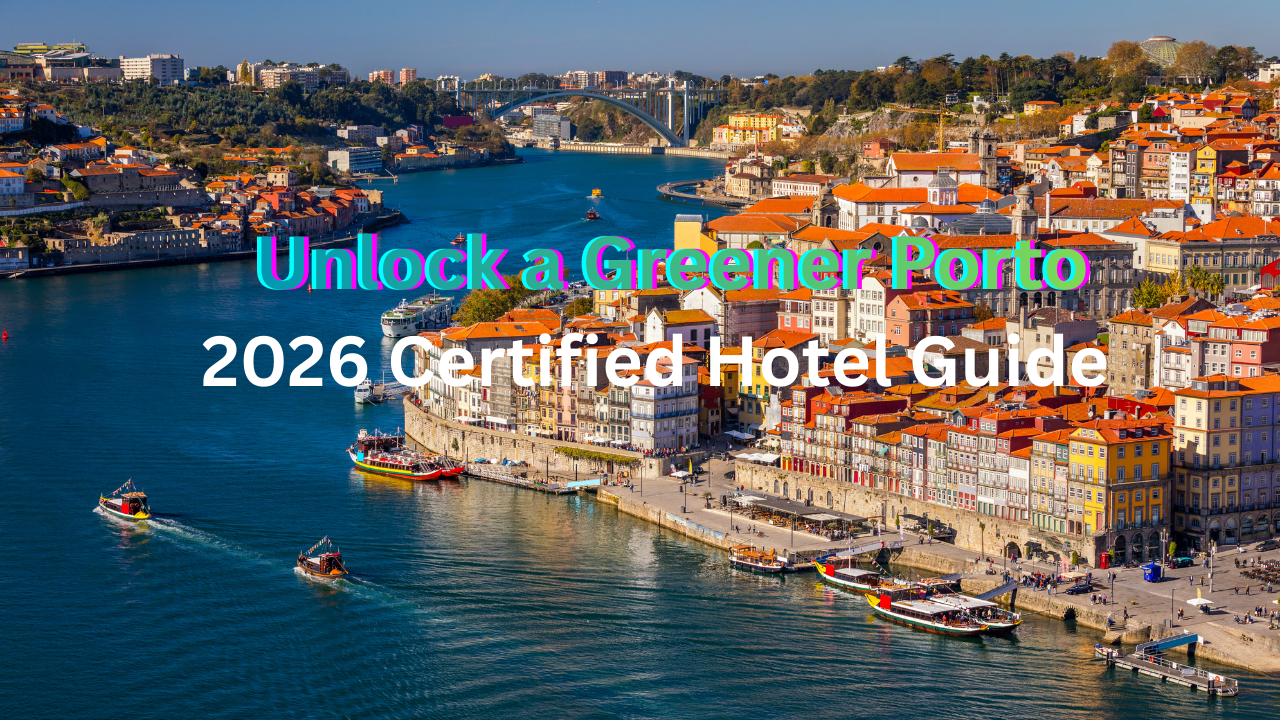
Green Key Certified Hotels in Porto: Adoption Without Saturation (2026 Guide)
Green Key Certified Hotels in Porto represent one of the most balanced and least distorted sustainability signals in the Iberian Peninsula. They attract far less attention than Lisbon’s rapidly expanding certified hotel market and are often left out of comparisons with Madrid and Barcelona. Yet when certification data is examined alongside urban form, transport efficiency, and market structure, Porto emerges as a compelling case of adoption without saturation.
According to the Green Key International certification registry (December 2025), Porto lists 34 Green Key certified hotel properties. That number is significantly lower than Lisbon’s 61 but higher than both Madrid’s 24 and Barcelona’s 15. For a smaller, more compact city, this positioning is not accidental. It reflects how sustainability certification functions differently when density, walkability, and transport access already support lower-impact travel patterns.
This guide takes a data-driven look at Green Key Certified Hotels in Porto, explaining why Porto’s measured adoption may be more resilient than either Lisbon’s scale-driven model or Barcelona’s scrutiny-heavy approach as we move into 2026.
What Porto’s Green Key Data Shows
Porto has 34 Green Key Certified Hotels as of December 2025.
Adoption is broad enough to be meaningful, but not yet saturated.
Certification in Porto functions as a differentiation signal, not a baseline requirement.
Urban compactness and walkability materially reduce the marginal impact of accommodation choice.
Transport access often outweighs incremental differences in hotel operations.
Compared with Lisbon, Madrid, and Barcelona, Porto occupies a structural middle ground that preserves certification value.
Understanding Green Key Certification in the Porto Context
Green Key is an international eco-label administered by the Foundation for Environmental Education, widely used across Europe to certify hotels that meet defined environmental management standards
official programme reference: Greenkey Global
According to Green Key programme criteria, certification requires hotels to demonstrate:
-
energy and water efficiency measures
-
waste reduction and separation systems
-
environmental management procedures
-
staff training and guest awareness initiatives
criteria overview: Green Key Global
What Green Key certification does not require is:
-
disclosure of absolute carbon footprints
-
accounting for guest transport or mobility emissions
-
supply-chain sustainability reporting
-
comparative ranking between certified hotels
For Green Key Certified Hotels in Porto, this distinction matters. Certification confirms the presence of sustainability systems, but urban context determines how effective those systems are in practice.
Green Key Certified Hotels in Porto: Verified Numbers and Scope
According to the December 2025 Green Key registry, Porto includes:
-
34 Green Key Certified Hotels
-
34 distinct properties (no duplicate listings under alternate names)
-
Certification validity extending into 2026 or later
This places Porto between:
-
Lisbon: 61 certified hotels (baseline normalization)
-
Madrid: 24 certified hotels (discipline-driven adoption)
-
Barcelona: 15 certified hotels (selective governance confirmation)
For deeper context on Lisbon’s scale-driven model, see:
10 Green Key Certified Hotels in Lisbon: What to Actually Expect (2026 Guide)
For cities where certification plays a more selective role:
Green Key Certified Hotels in Madrid and Barcelona: The Good Reason Behind Fewer Green Certifications (2026 Guide)
Why Green Key Certified Hotels in Porto Avoid Saturation
Porto’s Hotel Market Structure
Porto’s hospitality market differs structurally from Lisbon’s. It is shaped by:
a compact historic core
limited large-scale hotel developments
strong leisure demand balanced by moderate business travel
Unlike Lisbon, where Green Key certification has become a baseline expectation, Green Key Certified Hotels in Porto remain selective. Hotels pursue certification to signal commitment, not merely to avoid standing out.
This preserves the interpretive value of the label.
Porto vs Lisbon: Adoption Without Saturation vs Normalization at Scale
Lisbon’s Green Key story is one of rapid normalization. Certification answers a basic question:
“Is sustainability addressed at all?”
In Porto, certification answers a different question:
“Is this hotel making an explicit sustainability commitment?”
This difference matters because labels lose meaning when everyone has them. Porto’s slower, steadier adoption curve has prevented certification from becoming background noise.
For a broader Iberian comparison, see:
Iberian Transport Comparison: A Data-Driven Face-Off of 5 Key Travel Routes
Urban Form: Porto’s Structural Sustainability Advantage
One of the most underappreciated factors in hotel sustainability analysis is urban form.
Porto benefits from:
-
high walkability
-
dense central neighborhoods
-
short travel distances
-
strong public transport coverage
As a result, Green Key Certified Hotels in Porto benefit from structural sustainability advantages that certification frameworks do not measure.
A centrally located Porto hotel with modest operational systems can outperform a peripheral certified hotel in Lisbon once guest mobility is considered.
This aligns with findings from:
The Iberian Transport Sustainability Score
The Transport Variable: Why Location Often Matters More Than Certification
Green Key certification focuses on hotel operations. It does not capture:
-
how guests arrive in the city
-
how they move between neighborhoods
-
whether trips rely on cars or public transport
In Porto, compactness reduces the marginal impact of accommodation choice. This reinforces a broader Iberian insight:
Transport decisions frequently dominate total travel emissions.
For illustration, see:
Lisbon to Seville Sustainable Transport: Your Complete Guide to Eco-Friendly Travel
Green Key Certified Hotels in Porto Compared to Madrid and Barcelona
Madrid and Barcelona represent two different certification environments:
Madrid emphasizes regulatory compliance and operational discipline.
Barcelona applies higher governance and disclosure scrutiny.
Porto sits between these models.
Compared to Madrid:
Green Key remains a voluntary signal, not a redundant one.
Compared to Barcelona:
Certification is not burdened by heavy governance expectations.
This makes Green Key Certified Hotels in Porto easier to interpret and less prone to misclassification.
Certification Density vs Certification Meaning
A recurring error in sustainability analysis is assuming that more certifications equal better outcomes.
In practice:
High density raises baseline standards but erodes differentiation.
Low density preserves meaning but limits coverage.
Porto’s 34 certified hotels strike a balance. Certification is common enough to matter, but rare enough to remain meaningful.
Methodology and Data Integrity
This analysis is based on the Green Key International registry (December 2025). Hotel counts were extracted using country code (PRT) and city field (Porto). No weighting was applied for hotel size, room count, or brand portfolio.
Certification is treated as a baseline signal, not as a performance ranking. Absence of certification is not interpreted as poor sustainability performance, particularly in contexts where urban form or regulation may substitute for voluntary labels.
Limitations include the absence of:
hotel-level carbon disclosure
Scope 3 emissions data
standardized transport-emissions accounting
The analysis prioritizes comparability and interpretive clarity over precision.
What This Means for Travelers

For travelers choosing Green Key Certified Hotels in Porto:
Certification remains a useful signal.
Central location often matters more than incremental operational differences.
Walkability and transport access amplify sustainability benefits.
Porto is one of the few Iberian cities where location efficiency and certification tend to reinforce each other.
What This Means for Corporate Travel and ESG Teams

For ESG, procurement, and institutional audiences:
Porto’s certification landscape is less noisy than Lisbon’s.
Green Key retains value as a differentiator, not merely a filter.
Due diligence remains necessary, but interpretation is clearer.
Looking Ahead to 2026: Risks and Opportunities
For Green Key Certified Hotels in Porto, the next phase involves:
avoiding rapid certification saturation
maintaining differentiation
integrating transport and location into sustainability narratives
If Porto mirrors Lisbon too quickly, certification value may erode. If it remains selective, Green Key can continue to function as a meaningful signal.
Final Take: Why Adoption Without Saturation Matters
Green Key Certified Hotels in Porto show that sustainability adoption does not need to scale aggressively to be effective. Porto’s approach steady, selective, and supported by favorable urban form may prove more resilient than either Lisbon’s saturation or Barcelona’s scrutiny-heavy model.
As sustainability labels become more common across Europe, preserving meaning may matter more than maximizing counts.
Porto shows how that balance can work.
Sources
Green Key International — Programme and Registry
https://www.greenkey.globalGreen Key Certification Criteria
https://www.greenkey.global/criteriaEuropean Commission — Sustainable Tourism Framework
https://single-market-economy.ec.europa.eu/sectors/tourism/sustainable-tourism_en




 English