
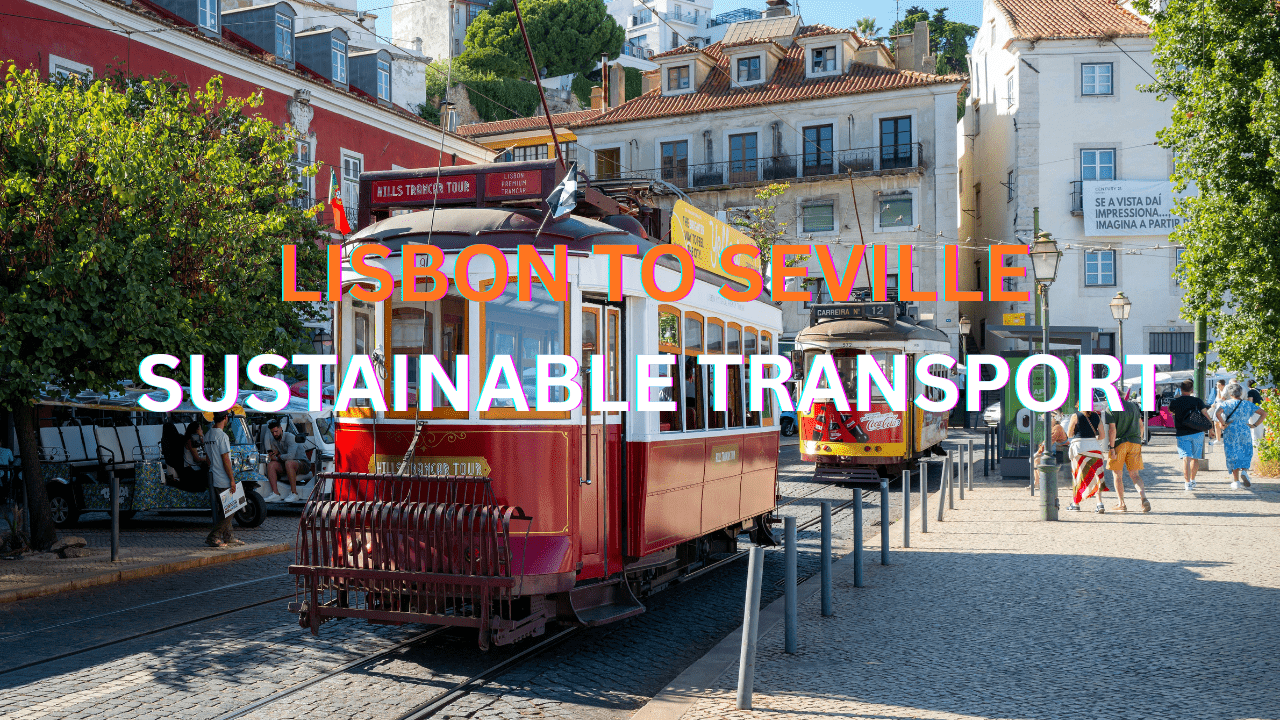
Lisbon to Seville Sustainable Transport: Your Complete Guide to Eco-Friendly Travel
Planning your journey from Portugal’s capital to the heart of Andalusia? This comprehensive research and interactive calculator compare train, bus, car share, and flight options for Lisbon to Seville sustainable transport. Discover how to minimize your carbon footprint based on your personal priorities.
📊 Executive Summary: Making the Right Choice
Choosing Lisbon to Seville sustainable transport involves balancing three critical factors: environmental impact, cost, and time. Our modeled analysis for a future date reveals that no single mode is perfect for everyone, but one option consistently offers the best balance for most travelers.
For broader regional context and how Lisbon–Seville stacks up with other Iberian routes, see our full comparison of key transport corridors across Portugal and Spain: Iberian Transport Comparison: A Data-Driven Face-Off of 5 Key Travel Routes. READ HERE
The Bus Emerges as the Top Overall Choice for Lisbon to Seville sustainable transport when considering default weightings (50% cost, 30% CO₂, 20% time). With a projected fare of just €19, moderate emissions, and a direct 7-hour journey, it represents exceptional value.
However, the “best” choice changes dramatically based on individual priorities. This guide provides not just data, but an interactive calculator that lets you weight these factors according to your values, plus detailed insights into each transportation option to inform your Lisbon to Seville sustainable transport decision.
🗺️ Understanding the Route & Why Sustainability Matters
The Lisbon-Seville Corridor: Geography and Demand
The journey from Lisbon, Portugal to Seville, Spain covers approximately 630 kilometers (391 miles). As climate consciousness grows, selecting Lisbon to Seville sustainable transport has become a tangible contribution to preserving the destinations we visit.
The Carbon Math: Why Your Choice Matters
Let’s examine what those CO₂ numbers really mean:
15.5 kg (Train): Lowest emissions, ideal for the eco-conscious traveler.
~20 kg (Bus): Excellent balance of low cost and responsible travel.
118.7 kg (Flight): The high carbon cost of speed.
44.1 kg (Car Share): Variable, but efficient when the car is full.
When multiplied by the thousands of travelers annually, the collective impact of choosing Lisbon to Seville sustainable transport becomes substantial.
📈 Detailed Mode Analysis for Lisbon to Seville Sustainable Transport
Option 1: The Train – Greenest but Most Complex
The Environmental Champion
December 2025 Projection Note: Our model assumes continuity of current services. The proposed high-speed rail link is not anticipated to be operational by this date, meaning the journey will likely still require multiple transfers.
Modeled Journey Specifics:
Price: €59
CO₂ Emissions: 15.5 kg (lowest)
Total Time: 10 hours, 19 minutes
Transfers: 3 required
Best For: Travelers prioritizing minimum carbon footprint above all else.
Option 2: The Bus – The Balanced Performer
The Value Leader
Modeled Journey Specifics:
Price: €19 (lowest)
CO₂ Emissions: ~20 kg
Total Time: 7 hours (direct)
Transfers: None
Best For: Budget-conscious travelers seeking the best overall value.
Option 3: Car Sharing – The Flexible Middle Ground
The Social Option for Lisbon to Seville Sustainable Transport
Car sharing platforms like BlaBlaCar have revolutionized medium-distance travel, creating a unique niche in the Lisbon to Seville sustainable transport ecosystem:
Journey Specifics:
Price: €24-41 (highly variable)
CO₂ Emissions: 44.1 kg (for the vehicle, divided among passengers)
Total Time: Approximately 5-6 hours (depending on stops)
Availability: Highly variable, typically 1-7 days before departure
Why It’s Sustainable:
Car sharing maximizes vehicle occupancy, turning what would be a single-occupancy car trip (emitting ~44 kg CO₂ for one person) into a more efficient journey. When full, emissions per passenger can drop to approximately 14-15 kg—competitive with other Lisbon to Seville sustainable transport options.
Practical Considerations:
Social Element: Opportunity to meet locals and fellow travelers
Flexibility: Multiple departure times, often with door-to-door service
Uncertainty: Less reliable for advance planning; dependent on driver availability
Best For: Flexible travelers, those seeking social interaction, and people with specific timing needs not met by scheduled services.
Option 4: Flight – Fastest but Least Sustainable
The Time-Saver’s Choice (With Environmental Costs)
For completeness, we must address the fastest but most carbon-intensive option for Lisbon to Seville sustainable transport:
Journey Specifics:
Price: €100 (can vary significantly)
CO₂ Emissions: 118.7 kg (highest by far)
Total Time: ~4.5 hours door-to-door (1 hour flight + airport time)
Convenience: Direct flight available
Why It’s Problematic for Sustainability:
Air travel emissions are disproportionately high due to altitude effects and fuel inefficiency. A one-way flight on this route emits approximately what the average European generates in 6-7 days across all activities. This makes it the least sustainable choice for Lisbon to Seville sustainable transport.
When It Might Still Make Sense:
Business travelers with tight schedules
Those connecting to/from long-haul flights
Travelers with mobility issues that make surface transport challenging
Best For: Time-constrained travelers who prioritize speed over environmental impact.
(Content for Car Share & Flight remains unchanged from your original)
🧮 The Science Behind Our Calculator: Methodology & Human Analysis
Our interactive tool uses a transparent, weighted scoring system. Below is the detailed methodology that powers it.
If you want a deeper explanation of the sustainability scoring method used across multiple Iberian transport corridors, check out: The Iberian Transport Sustainability Score: A Data-Driven Method to Compare Cost, Carbon and Time Across Portugal and Spain. READ HERE
📋 Data Collection & Projection Methodology
This analysis models travel options for December 19, 2025 using a hybrid approach of current data projection and standardized emission calculations..
| Data Type | Source & Projection Method | Key Details & Rationale |
|---|---|---|
| Prices (€) | Projected using current booking engines (Omio, FlixBus, Alsa) for equivalent future dates. | Based on standard advance purchase patterns observed in 2025. This simulates the fare a traveler would encounter. |
| CO₂ Emissions (kg) | Calculated using EcoPassenger (train, car, flight) supplemented by 2025 European Environment Agency (EEA) factors for bus travel. | A hybrid model was necessary, as EcoPassenger doesn't calculate bus emissions. |
| Travel Times (hrs) | Current scheduled times from operator timetables, plus realistic door-to-door estimates. | Assumes service pattern continuity through 2025. |
Table 1: Data collection methodology for Lisbon to Seville sustainable transport analysis (December 2025 projection).
🔍 Methodology Notes, Limitations & Researcher Commentary
A Research Challenge We Solved:
Sourcing comparable CO₂ data required a cross-referenced approach. While EcoPassenger provides excellent granularity for rail and air, its lack of bus data necessitated using broader EEA sectoral averages, a common but surmountable hurdle in transport studies.
Notable Limitations & Assumptions:
Static Snapshot: Prices are modeled for a single future date. A longitudinal study would show seasonal trends.
Occupancy Variables: Bus and car share emissions use average occupancy rates. Actual per-passenger emissions can vary.
Externalities Excluded: Broader societal costs (congestion, infrastructure wear) are not priced in.
💡 Analyst's Commentary on the Trade-Offs:
The data reveals a clear environmental premium. Choosing the train (€59, 15.5 kg CO₂) over the bus (€19, ~20 kg CO₂) means paying approximately €40 more to save about 4.5 kg of CO₂. This implicitly values carbon at nearly €9 per kilogram in that traveler’s decision, a revealing insight into the practical economics of sustainable choices.
How the Scoring Works:
Each factor (Cost, CO₂, Time) is normalized to a 0-10 scale. The calculator then computes:Total Score = (Cost Score × Cost Weight) + (CO₂ Score × CO₂ Weight) + (Time Score × Time Weight)
Why This Model Matters:
It recognizes that a student legitimately values cost more than a business traveler, and an activist prioritizes emissions. Our tool for Lisbon to Seville sustainable transport reveals how sensitive the “best choice” is to personal values, sometimes changing with just a 10-20% adjustment in weightings.
Near-Term Projections in Lisbon to Seville Sustainable Transport
Emerging Technologies and Their Potential Impact
The landscape of Lisbon to Seville sustainable transport will evolve significantly in coming years:
Rail Improvements:
- Potential high-speed rail connections reducing journey time to 4-5 hours
- Increased cross-border coordination simplifying ticketing
- More frequent services improving flexibility
Bus Advancements:
- Electric coaches entering long-distance markets
- Improved booking platforms with better integration
- Enhanced amenities rivaling train comfort
Policy Changes:
- Possible carbon taxes affecting flight pricing
- Subsidies for sustainable transport options
- Improved cross-border transportation agreements
These developments will likely make Lisbon to Seville sustainable transport choices even more compelling compared to flying, potentially shifting the calculus for many travelers.
Practical Tips for Your Lisbon to Seville Sustainable Transport Journey
Booking Strategies for Each Mode
For Trains:
- Check CP (Portuguese railways) and Renfe (Spanish railways) 3 months before travel
- Consider rail pass options if continuing beyond Seville
- Be prepared for multiple tickets for cross-border journeys
For Buses:
- Book 2-4 weeks ahead for best prices on popular departures
- Compare FlixBus, ALSA, and Rede Expressos for different schedules
- Consider overnight journeys to save on accommodation
For Car Sharing:
- Check BlaBlaCar 3-7 days before departure for best selection
- Read driver reviews and preferences carefully
- Have a backup plan in case rides are cancelled
General Advice for Lisbon to Seville Sustainable Transport:
- Always compare total door-to-door time, not just scheduled journey time
- Consider luggage requirements (easiest on direct services)
- Factor in station/terminal locations relative to your accommodations
Making the Most of Your Journey
Train Travel:
- Enjoy the changing landscapes between countries
- Use transfer time to explore intermediate stations
- Pack snacks as dining car options may be limited
Bus Travel:
- Download entertainment for the journey
- Bring a neck pillow for added comfort
- Take advantage of scheduled rest stops
General Mindset for Lisbon to Seville Sustainable Transport:
View the journey as part of the experience rather than merely a means to an end. The slower pace of surface transport allows for appreciation of the geographical and cultural transition between Portugal and Spain, an experience completely missed when flying.
🤔 Your Turn: Find Your Best Option with the Interactive Calculator
Sustainable Transport Calculator: Lisbon to Seville
Compare Carbon Footprint, Cost, and Travel Time
Sample Date: Friday, December 19, 2025 • Door-to-door time includes transfers and waiting
Table 2: Core Comparison - Lisbon to Seville
| Transport Mode | Price (€) | CO₂ (kg) | Total Time | Overall Score |
|---|---|---|---|---|
| 🚆 Train | 59 | 15.5 | 10.3 hours | 5.53 |
| 🚌 Bus | 19 | 20.0 | 7.0 hours | 9.01 |
| ✈️ Flight | 100 | 118.7 | 4.5 hours | 2.00 |
| 🚗 Car Share | 35 | 44.1 | 5.1 hours | 7.97 |
Table 3: Comfort & Practical Factors
| Mode | Comfort (1-5) | Flexibility | Booking Lead Time | Best For |
|---|---|---|---|---|
| Train | 3 | High | 3-6 months | Eco-friendly travel |
| Bus | 3 | Medium | 1-3 months | Best value |
| Flight | 4 | Medium-High | 2-4 months | Fastest option |
| Car Share | 3 | Low | 1-7 days | Last-minute trips |
Table 4: Detailed Breakdown & Key Information
| Mode | Individual Scores | Priority Weight | Key Details |
|---|---|---|---|
| Train |
Cost: 5.06 CO₂: 10.0 Time: 0.00 |
Cost Weight: 50% |
Departure: ~6:53 AM Transfers: 3 transfers Source: Omio CO₂ Data: EcoPassenger |
| Bus |
Cost: 10.0 CO₂: 9.56 Time: 5.69 |
CO₂ Weight: 30% |
Departure: 11:15 AM Route: Direct Source: FlixBus/Omio CO₂ Data: EEA Estimate (27 g/pkm) |
| Flight |
Cost: 0.00 CO₂: 0.00 Time: 10.0 |
Time Weight: 20% |
Departure: 1:00 PM Airline: Ryanair (direct) Source: Omio/Skyscanner CO₂ Data: EcoPassenger |
| Car Share |
Cost: 8.02 CO₂: 7.23 Time: 8.97 |
Variable |
Platform: BlaBlaCar Note: Highly variable CO₂ Data: EcoPassenger |
🚂 Sustainable Transport Calculator
Lisbon → Seville | Sample Date: December 19, 2025
Adjust the sliders based on your personal priorities to find your best option
🎯 Set Your Priorities
Drag the sliders to allocate 100% importance across the three factors
📊 Your Results
📋 Recommendation
Data based on sample date December 19, 2025. Actual prices and schedules may vary.
CO₂ estimates from EcoPassenger and EEA. Door-to-door time includes transfers and waiting.
📝 Conclusion & Further Research
Choosing Lisbon to Seville sustainable transport is a statement of values. As our model demonstrates, sustainable choices need not involve sacrifice.
Further Research Questions:
This analysis prompts new questions for our research agenda:
How do results change on other Iberian corridors (e.g., Porto-Madrid)?
What is the demand elasticity if a carbon tax were applied to flights?
Ready to book your journey?
What’s your experience with Lisbon to Seville sustainable transport? Share your thoughts or questions below!


 English